How ERP Supports Multi-Branch and Multi-Company Businesses
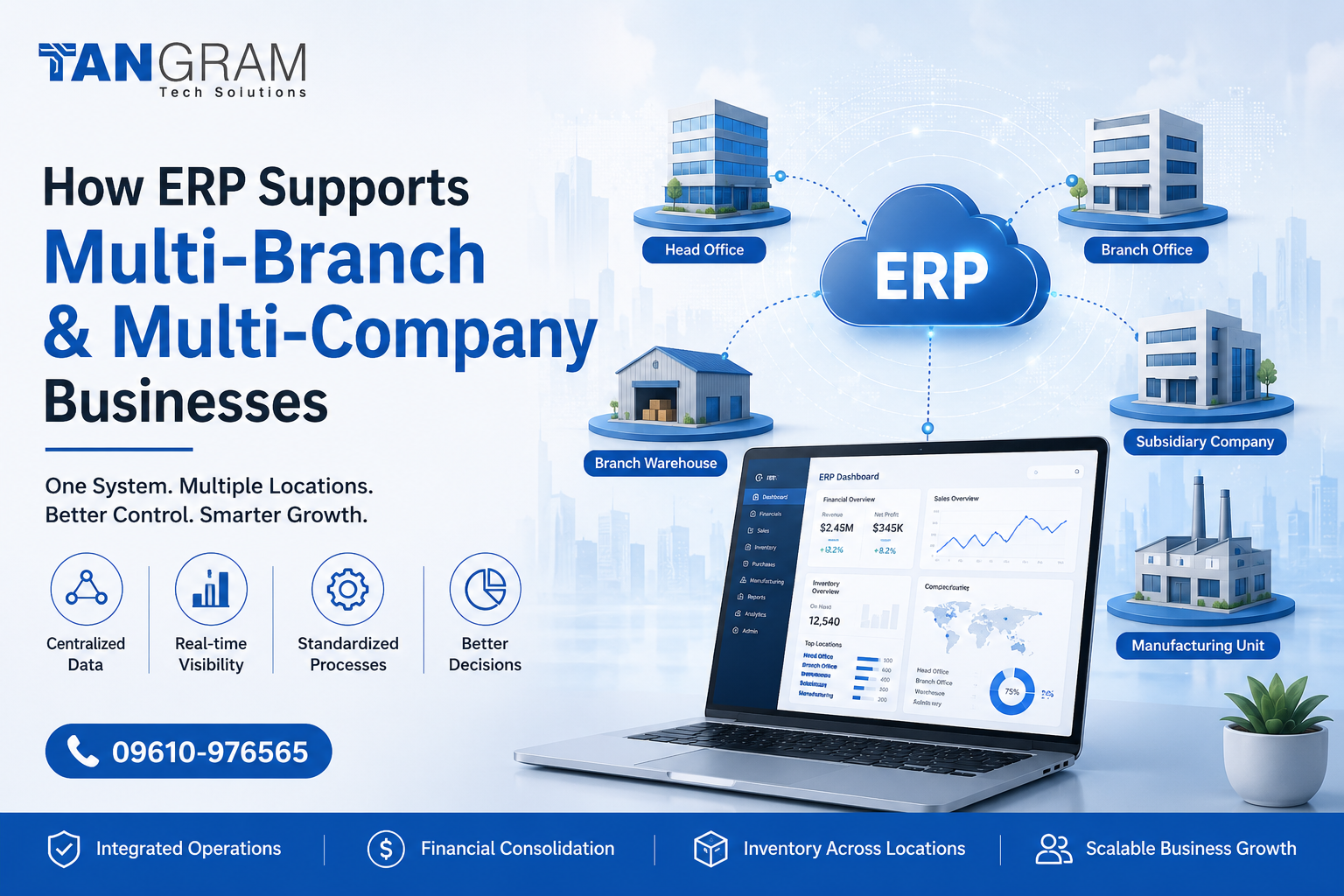
As a business grows, opening new branches or managing multiple companies can create new challenges. Finance, inventory, sales, purchasing, customer information, and reporting all become harder to manage when every location uses separate spreadsheets or disconnected software.
This often leads to duplicate data, delayed reports, inconsistent information, and limited visibility. An ERP system brings these activities together in one place, making it easier to manage different branches and companies while keeping the business organized.
Why Multi-Branch Businesses Need ERP
Managing a single location is usually straightforward. But once a business adds branches, warehouses, or separate companies, keeping track of everything becomes more complicated.
ERP connects important business activities through one system. Management can monitor individual branches while also getting a clear picture of overall business performance.
1. Centralized Business Information
Instead of keeping separate files for each branch, businesses can manage important information through a centralized ERP system. Employees can access the data they need, while management can view information across the organization.
This reduces duplicate work and helps keep business data more consistent.
2. Better Financial Management
Managing finances across several branches or companies can quickly become complicated. ERP helps businesses track revenue, expenses, receivables, payables, budgets, and other financial information more efficiently.
For businesses using NetSuite OneWorld, multiple legal entities can be managed through a structured subsidiary system with consolidated financial reporting. This is particularly useful for organizations operating across different companies or regions.
3. Improved Inventory Visibility
Inventory management becomes more challenging when products are stored across several locations.
An integrated ERP system allows businesses to monitor inventory across branches, understand product availability, and identify where additional stock may be needed. This can help improve purchasing decisions and reduce unnecessary inventory.
4. Consistent Processes Across Branches
Different branches may develop their own ways of handling sales, purchasing, approvals, and reporting.
ERP helps businesses establish consistent processes across locations while still allowing branches to handle their specific operational needs. This makes it easier for management to maintain control as the organization grows.
5. Faster Reporting and Better Decisions
Business leaders need to know how the entire organization is performing, not just one branch.
ERP dashboards and reports bring information together, making it easier to monitor sales, inventory, expenses, and financial performance. Instead of spending hours collecting information from different spreadsheets, management can make decisions using centralized business data.
6. Easier Multi-Company Management
Businesses with multiple legal entities often have to deal with intercompany transactions, financial consolidation, and different reporting requirements.
NetSuite OneWorld supports multiple subsidiaries, intercompany transactions, consolidated reporting, and multiple currencies. These capabilities can be valuable for organizations that are expanding and managing increasingly complex business structures.
Why This Matters for Businesses in Bangladesh
Many businesses in Bangladesh are expanding into new locations, warehouses, and business units. Manufacturers, distributors, retailers, and service companies can quickly find it difficult to manage growing operations with spreadsheets and separate software.
For companies looking for ERP in Bangladesh, ERP software in Bangladesh, or NetSuite in Bangladesh, scalability should be an important consideration.
The right ERP should solve today’s challenges while giving the business enough flexibility to support future growth.
How NetSuite Supports Business Growth
Oracle NetSuite is a cloud based business management platform, while NetSuite OneWorld provides capabilities for organizations managing multiple legal entities and subsidiaries.
By bringing financial and operational information together, businesses can improve visibility and manage different locations more efficiently.
However, choosing the right ERP is only part of the process. Proper implementation is equally important. The system should be configured around the company’s structure, workflows, reporting needs, and long term goals.
Tangram provides Oracle NetSuite implementation, customization, integration, data migration, training, support, and post implementation services for businesses in Bangladesh.
Conclusion
Managing multiple branches and companies does not have to mean managing multiple disconnected systems.
A well implemented ERP solution can bring business information together, improve financial and inventory visibility, standardize processes, and help management make better decisions.
For growing organizations, ERP can provide the foundation needed to manage expansion with greater confidence. If your business is adding branches, managing multiple companies, or struggling to bring information together, it may be time to consider a scalable ERP solution.