
How AI Is Changing ERP and Transforming Modern Businesses
For many years, ERP systems have helped businesses keep important operations connected. Finance, inventory, sales, purchasing, customer information, and reporting could all be managed through one system instead of multiple disconnected files and applications.
Now, ERP is changing again.
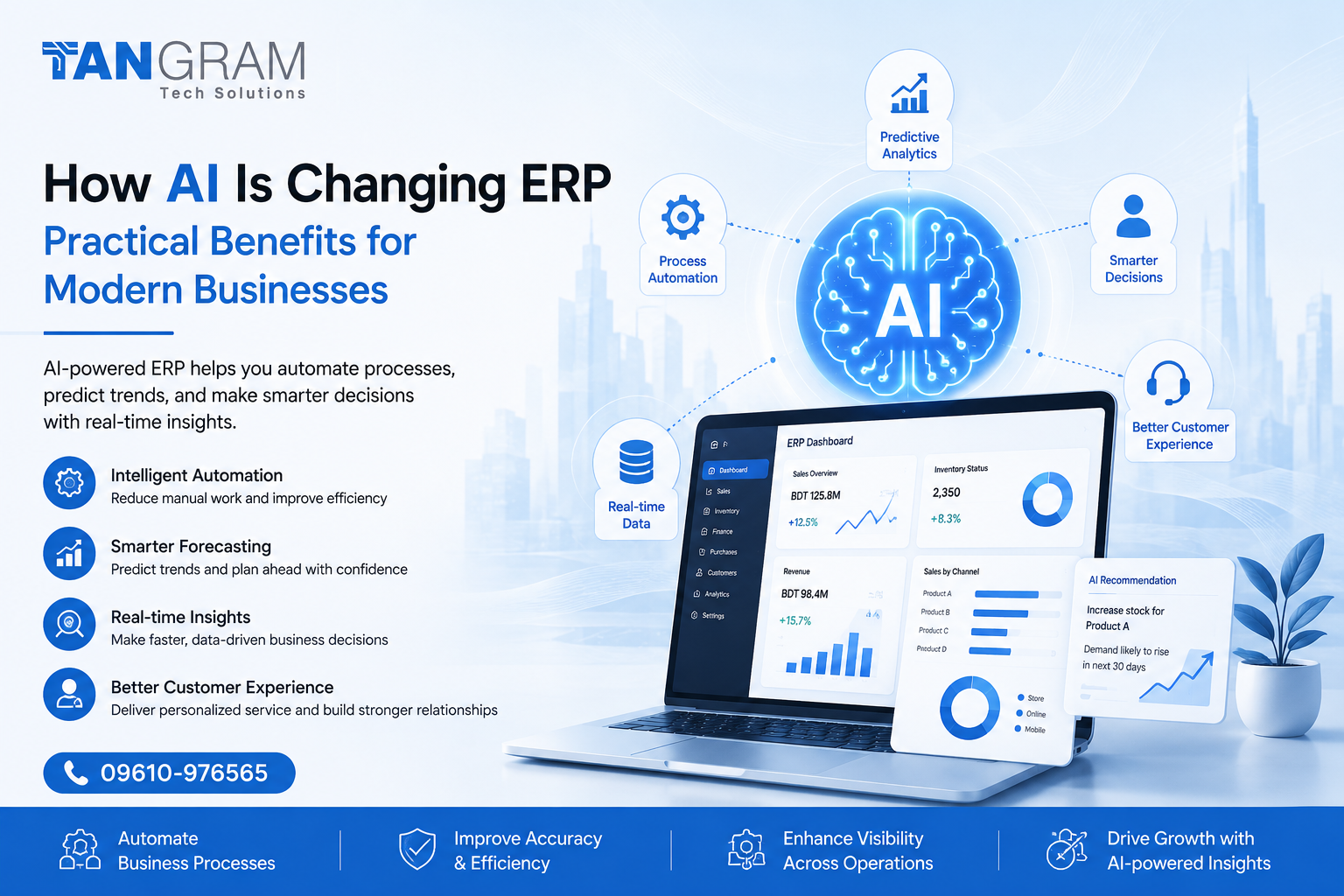
Artificial Intelligence is adding another layer to the way businesses use their ERP systems. Instead of only recording transactions and showing reports about what has already happened, AI can help businesses identify patterns, automate routine work, improve forecasting, and make information easier to understand.
For businesses looking for ERP in Bangladesh, this is becoming increasingly relevant. As companies grow, the amount of data they manage also increases. The challenge is no longer simply collecting information. The real challenge is understanding that information and using it at the right time.
AI Makes ERP Automation More Useful
Many businesses still spend a significant amount of time on repetitive tasks. Employees may enter information manually, prepare reports, review transactions, or search through different systems to find the information they need.
AI can help reduce some of this work by making automation more intelligent.
For example, AI can help identify unusual transactions, organize information, process routine tasks, and help employees find relevant business data more quickly.
The purpose is not to replace people. Instead, AI can reduce the time spent on repetitive administrative work and allow employees to focus more on customers, problem-solving, and decisions that require human experience.
When AI is connected with an ERP system, it can work with the actual information already being used across the business.
Better Forecasting and Business Planning
One of the most useful applications of AI in ERP is forecasting.
Businesses regularly need to estimate future sales, customer demand, inventory requirements, and operational needs. Traditionally, these decisions may depend on historical reports, spreadsheets, and manual calculations.
AI can help analyze larger amounts of business data and identify patterns that may be difficult to notice manually.
A retailer, for example, may gain a better understanding of which products are likely to experience higher demand. A distributor may use historical sales and inventory information to support purchasing decisions. A manufacturer may use available data to improve production planning.
Forecasts will never remove every uncertainty from business. However, better information can give management a stronger starting point when planning for the future.
Faster and Smarter Decision Making
Business owners and managers often have access to plenty of information but not enough time to review everything.
AI can help by making important information easier to identify. It may highlight patterns, unusual activity, or changes that deserve attention.
Instead of waiting for someone to prepare and combine reports manually, decision makers can work with more timely business information.
This can be useful across sales, finance, purchasing, inventory, and other areas of the organization.
The quality of the data still matters. AI cannot create reliable insights from inaccurate or disconnected information. This is why a properly implemented ERP system provides such an important foundation.
Improved Inventory and Demand Management
Inventory is an area where better forecasting can make a noticeable difference.
Too much stock can increase storage costs and tie up working capital. Too little stock can result in missed sales and frustrated customers.
AI supported analysis can help businesses understand demand patterns and make better decisions about inventory and purchasing.
For companies managing several branches, warehouses, or sales channels, connected inventory information becomes even more important. Management can see what is happening across different locations and respond more quickly when demand changes.
For growing businesses in Bangladesh, this can reduce some of the guesswork involved in inventory planning.
Identifying Problems Before They Become Bigger
Some business problems are only discovered after they have already caused financial or operational damage.
AI and advanced analytics can help identify unusual patterns that may require attention. This could include unexpected changes in sales, unusual expenses, inventory movements, or other activities that do not follow normal patterns.
Early visibility gives management the opportunity to investigate a situation before it develops into a larger issue.
This can be particularly useful for businesses managing thousands of transactions where reviewing every record manually would take a considerable amount of time.
A Better Experience for Employees and Customers
AI can also make everyday ERP systems easier for employees to use.
Finding the right information can sometimes take longer than it should. Employees may need to search through spreadsheets, reports, emails, and different applications to answer a simple question.
AI powered tools can help make business information easier to access and understand.
When employees can find accurate information quickly, they can respond faster and work with greater confidence.
This can also improve the customer experience. Faster order processing, more accurate stock information, and quicker responses can all help create a smoother experience for customers.
What AI Means for ERP in Bangladesh
Businesses in Bangladesh are continuing to invest in digital transformation. As organizations expand, managing finance, inventory, sales, customers, and operations through disconnected systems becomes increasingly difficult.
For companies searching for NetSuite in Bangladesh, NetSuite ERP Bangladesh, or ERP software in Bangladesh, AI and intelligent automation are becoming important parts of the discussion.
However, AI should not be viewed as a solution to every business challenge.
Its value depends heavily on the quality of the business processes and data behind it. Before introducing advanced automation or analytics, businesses should make sure their core operations are properly organized and their ERP system reflects their actual requirements.
How NetSuite Supports Smarter Business Operations
Oracle NetSuite provides a cloud based business management platform that connects important functions, including finance, inventory, sales, customer management, and reporting.
Having these functions connected gives businesses a stronger foundation for automation, forecasting, and data driven decision making.
As AI capabilities continue to develop, businesses are looking for practical ways to use intelligent technologies alongside their existing business systems.
For a growing company, the real benefit comes from using technology to solve actual problems rather than adopting new tools simply because they are popular.
A business struggling with inaccurate forecasts may benefit from better demand analysis. A company spending too much time on repetitive work may benefit from automation. Management teams dealing with large amounts of data may benefit from better analytics and reporting.
The right approach will depend on the needs of the business.
The Future of AI Powered ERP
AI is not replacing ERP. It is making ERP more useful.
Traditional ERP systems help businesses organize and manage information. AI can help businesses gain more value from that information by supporting automation, forecasting, analysis, and faster insights.
For modern businesses, the focus should be practical. The question should not simply be, “How can we use AI?”
A better question is, “Which business problem can AI help us solve?”
When technology is connected to a real business need, it becomes much more valuable.
Conclusion
AI is changing ERP by making business systems more intelligent, responsive, and useful for everyday operations.
From automation and forecasting to inventory planning and business analytics, AI can help organizations reduce manual work and gain better visibility into what is happening across the business.
For companies exploring ERP in Bangladesh or NetSuite ERP Bangladesh, the combination of cloud ERP, automation, and AI can provide a stronger foundation for future growth.
Tangram Tech Solutions Ltd. helps businesses implement and optimize Oracle NetSuite ERP through implementation, customization, integration, data migration, training, and ongoing support.
As AI continues to develop, businesses with connected systems, reliable data, and well organized processes will be in a much stronger position to benefit from the opportunities ahead.