Retail ERP Solutions in Bangladesh: Managing Sales, Inventory, and Customers in One Place
Running a retail business becomes much more complicated as the number of products, customers, stores, and sales channels grows. One of the biggest challenges is keeping inventory information accurate.
A product may show as available in one record while the actual stock on the shelf tells a different story. At the same time, sales information may be stored separately, customer details may be scattered across different systems, and financial teams may have to spend hours matching records.
These small problems can eventually lead to lost sales, excess inventory, delayed reporting, and unhappy customers. This is where a Retail ERP solution can make everyday business management much easier.
Why Retail Businesses Need ERP
Retail is more than simply selling products. Businesses need to manage sales, inventory, purchasing, customers, finances, suppliers, and reporting at the same time.
The challenge becomes even greater when a company operates several branches or sells through both physical stores and online channels.
For example, when a product is sold, the transaction should affect inventory, sales records, customer information, and financial records. If each department manages its own system, employees may have to enter the same information several times.
An ERP system connects these activities through one platform, reducing unnecessary manual work and giving the business a clearer view of its operations.
What an All in One ERP Means for Retailers
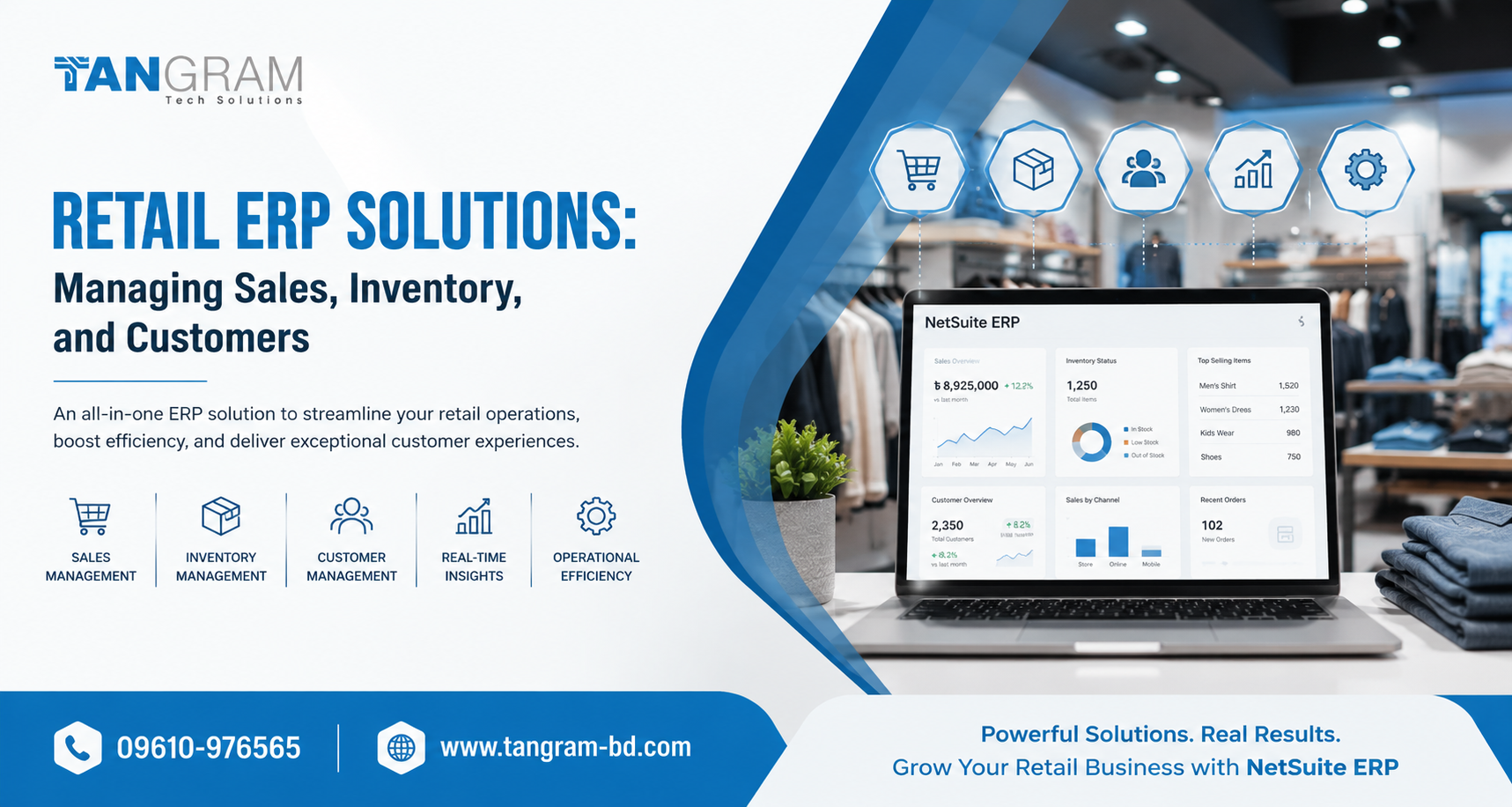
A retail ERP solution such as Oracle NetSuite connects important areas of the business, including sales, inventory, purchasing, customer information, and financial management.
For retailers, this can provide several practical benefits.
Better Inventory Visibility
Businesses can get a clearer picture of available stock across different stores and locations. This makes it easier to identify products that are selling quickly and those that may be sitting in storage for too long.
Smarter Purchasing Decisions
Purchasing teams can use sales and inventory information to make better decisions about when and what to reorder. This can help reduce unnecessary stock while keeping popular products available.
Better Customer Information
Customer details and purchase history can be managed in a centralized system. Employees can therefore understand customer needs more easily and provide more consistent service.
Simpler Financial Management
When sales, returns, and inventory information are connected with financial processes, accounting teams do not have to spend as much time manually matching information from different systems.
Why This Matters for Retail Businesses in Bangladesh
The retail market in Bangladesh is changing quickly. Many businesses now operate physical stores while also selling through websites, Facebook pages, marketplaces, and other online channels.
Customers expect accurate product availability and a smooth experience regardless of where they purchase.
Managing each sales channel separately can make this difficult. Stock information may not be updated quickly enough, and management may have to wait for different reports before understanding actual business performance.
A cloud ERP system can bring this information together and provide management with a more connected view of sales, inventory, customers, and finances.
How NetSuite Can Support Retail Businesses
Oracle NetSuite is a cloud based business management platform that connects financial management, inventory, sales, customer information, and reporting.
For a retailer operating multiple stores or sales channels, having these functions connected can reduce the need to maintain separate records.
For example, when a sale takes place, the relevant information can flow through connected business processes instead of requiring employees to update several different systems manually.
This can improve visibility and help businesses respond more quickly to changes in demand.
ERP for Multi Store Retail Businesses
Managing several retail locations can create additional challenges. Each branch may have different sales volumes, inventory levels, customers, and operational requirements.
With an integrated ERP system, management can monitor individual branches while also viewing the performance of the business as a whole.
This makes it easier to compare sales, track inventory, review expenses, and identify locations that may require additional attention.
Where Should Retailers Start?
A business does not have to change every process at once.
The best starting point is usually the area creating the biggest operational problem. For one retailer, it may be inaccurate inventory. For another, it could be managing multiple branches, controlling purchasing, or connecting online and offline sales.
Once the main challenges are identified, the ERP system can be planned around those priorities and expanded as the business grows.
This approach can also make the transition easier for employees because they can gradually adapt to the new processes.
Choosing the Right Retail ERP
The right ERP should do more than record sales. It should help connect the different parts of the business and provide information that management can actually use.
Retail businesses should consider factors such as inventory management, multi store support, financial management, reporting, customer management, integrations, scalability, and ease of use when evaluating an ERP solution.
For businesses searching for ERP in Bangladesh or NetSuite in Bangladesh, choosing an experienced implementation partner is also important. Proper configuration, data migration, employee training, and ongoing support can have a major impact on the success of an ERP project.
Tangram Tech Solutions Ltd. helps businesses in Bangladesh with Oracle NetSuite implementation, customization, integration, data migration, training, and ongoing support.
Conclusion
Retail businesses cannot afford to rely on disconnected information as they grow. Accurate inventory, timely sales information, reliable customer data, and efficient financial processes are essential for maintaining control and delivering better service.
A well implemented retail ERP system can bring these areas together in one connected environment.
For growing retailers in Bangladesh, Oracle NetSuite can provide the visibility, flexibility, and scalability needed to manage today’s operations while preparing for future growth.
If your business is still relying on spreadsheets, manual stock counts, or separate systems for different sales channels, it may be time to explore how a modern retail ERP solution can simplify your operations and help your business grow.