
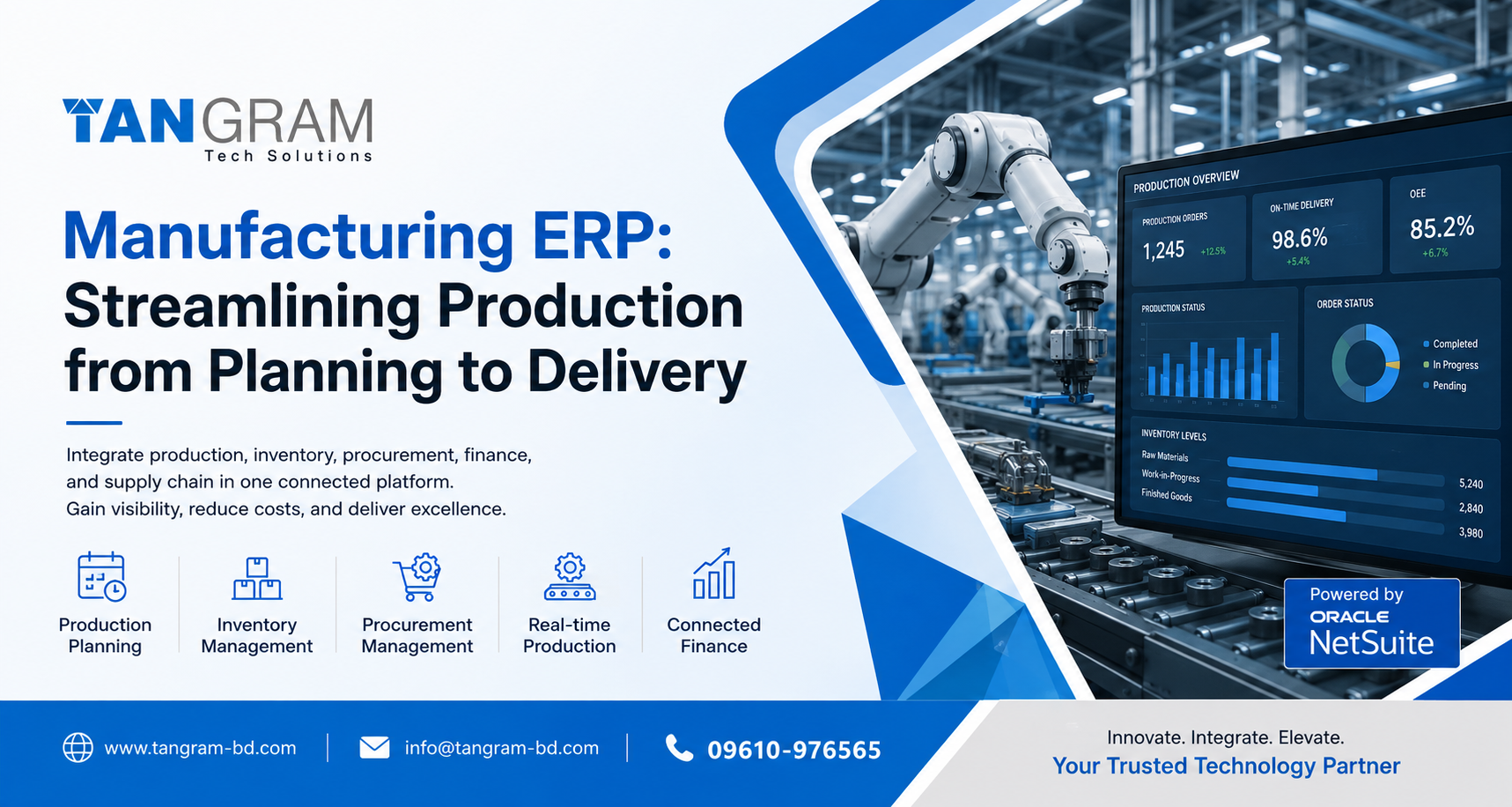
Manufacturing ERP in Bangladesh: Streamlining Production from Planning to Delivery
Walk into a manufacturing business in Bangladesh and you will often find different teams working with different sets of information. The production team may use spreadsheets for planning, the warehouse may maintain separate stock records, and the finance department may have its own system.
This makes daily operations more difficult than they need to be.
When information is scattered, managers may struggle to get a clear picture of what is happening. A shortage of raw materials may be discovered too late, production delays may not be reported quickly, and the actual cost of production may take time to calculate.
A Manufacturing ERP system helps bring these areas together, giving businesses a clearer view of operations from planning to production and final delivery.
From Production Planning to Final Delivery
Manufacturing is a connected process. Sales forecasts influence production plans, production plans determine material requirements, and raw materials need to be available when production begins. Once goods are produced, they move into inventory before being delivered to customers.
When every department works separately, information can easily become outdated or inconsistent.
An ERP system such as Oracle NetSuite connects important areas of the business through one platform. Production, inventory, purchasing, finance, and reporting can work with the same business information, reducing the need for constant manual updates and spreadsheet reconciliation.
Better Visibility on the Production Floor
One of the biggest challenges for manufacturers is knowing what is happening at the right time.
Managers need answers to practical questions. What is currently in production? Are there any delays? Do we have enough materials? Which orders need attention?
With connected ERP data, businesses can gain better visibility into production activities and make decisions based on current information instead of waiting for manually prepared reports.
Improved Inventory and Material Control
Raw materials are essential to keeping production moving. Too little inventory can delay production, while too much can increase storage costs and tie up valuable working capital.
A Manufacturing ERP system helps businesses maintain better visibility over materials, work in progress, and finished goods. This makes it easier to plan purchasing and reduce unnecessary stock-related problems.
Clearer Production Costing
Understanding the real cost of production is important for pricing and profitability.
When material costs, purchasing, production activities, and financial information are managed separately, calculating accurate costs can become time-consuming.
ERP brings these areas closer together, helping management gain a clearer understanding of business costs and overall performance.
Why Manufacturing ERP Matters in Bangladesh
Manufacturers in Bangladesh face increasing pressure to control costs, improve efficiency, meet delivery schedules, and maintain product quality.
Whether a business operates in garments, food processing, plastics, pharmaceuticals, or light engineering, reliable information can make a significant difference.
For companies searching for ERP in Bangladesh, ERP software in Bangladesh, or NetSuite ERP Bangladesh, the goal should not simply be to replace spreadsheets. The real benefit comes from connecting the different parts of the business and making information easier to access.
Why NetSuite Can Support Manufacturing Growth
Oracle NetSuite provides a cloud-based platform that can connect financial management, inventory, procurement, production-related processes, and reporting.
This gives growing manufacturers a more connected way to manage their operations. Instead of spending time collecting information from different files and systems, management can focus more on understanding performance and planning the next steps.
For businesses operating multiple departments, warehouses, or locations, a centralized system can also provide better visibility as the organization grows.
Start with the Problems That Matter Most
ERP implementation does not mean changing everything overnight.
A practical approach is to identify the areas creating the biggest challenges. For some manufacturers, the priority may be production planning. For others, it could be inventory accuracy, purchasing, costing, or reporting.
Starting with clear business priorities makes implementation easier and helps employees adapt to the new system more effectively.
Tangram Tech Solutions Ltd. helps businesses in Bangladesh with Oracle NetSuite implementation, customization, integration, data migration, training, and ongoing support.
Conclusion
Manufacturing becomes much harder to manage when production, inventory, purchasing, and finance operate as separate processes.
A well-implemented ERP system can connect these areas, reduce manual work, improve visibility, and give management access to more reliable business information.
For manufacturers in Bangladesh, a modern ERP solution can provide a stronger foundation for managing production from planning to delivery.
If your business still depends heavily on spreadsheets, manual reporting, and information collected from different departments, it may be the right time to explore how Oracle NetSuite ERP can support more efficient and connected manufacturing operations.
Lorem ipsum dolor sit amet, consectetur adipiscing elit. Ut elit tellus, luctus nec ullamcorper mattis, pulvinar dapibus leo.