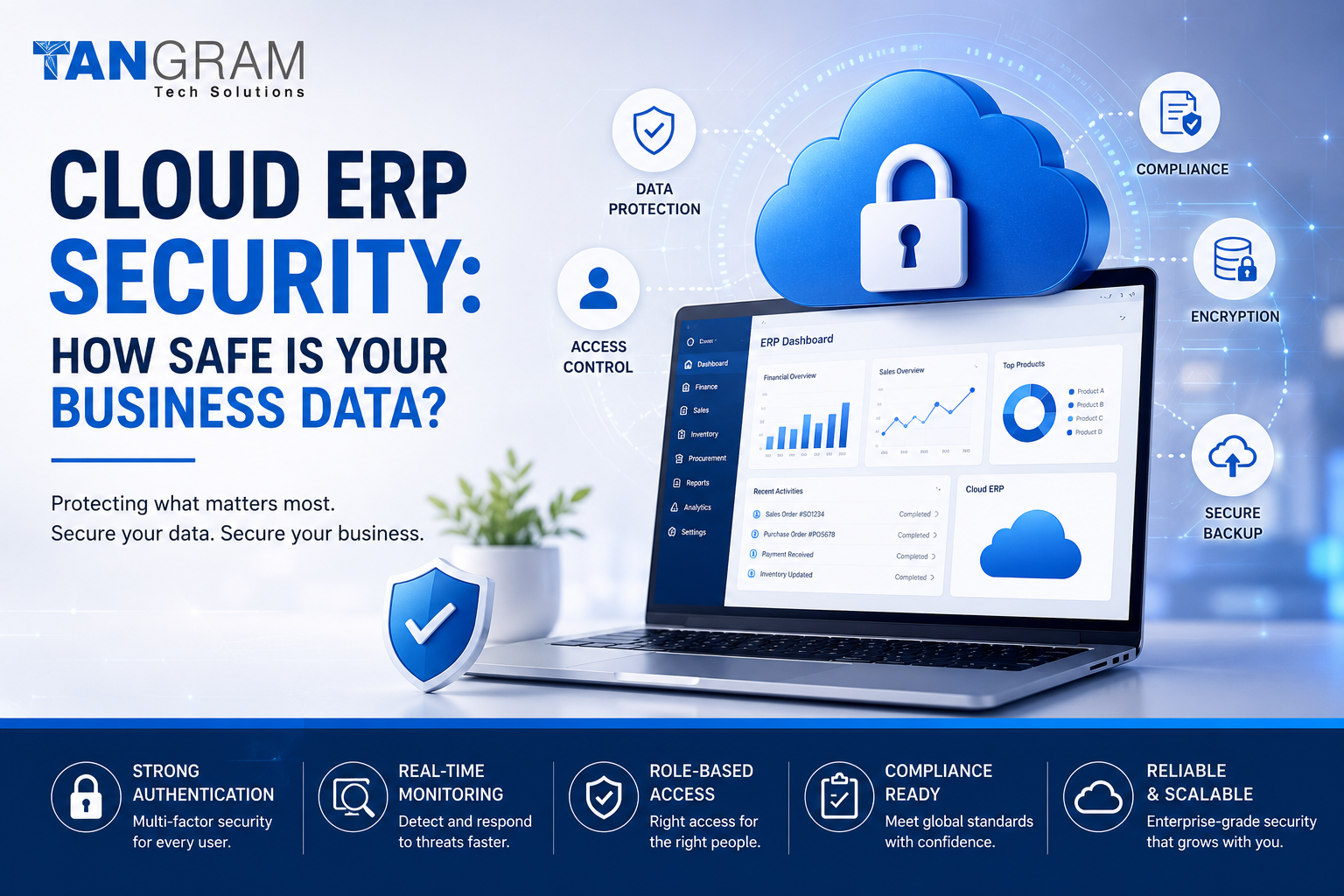
Cloud ERP Security: How Safe Is Your Business Data?
For many businesses, moving critical operations to the cloud raises an understandable question: How safe is our business data?
ERP systems often store some of the most important information in an organization. Financial records, customer details, supplier information, employee data, inventory, sales transactions, and business reports may all be managed through the same platform.
That makes security more than an IT issue. It is a business priority.
The good news is that modern cloud ERP platforms are designed with multiple layers of security. However, choosing a secure platform is only one part of the equation. The way the system is implemented, configured, and managed also plays a major role in protecting business data.
What Is Cloud ERP Security?
Cloud ERP security refers to the technologies, controls, and business practices used to protect an ERP system and the information stored within it.
This may include user authentication, role-based permissions, encryption, audit trails, activity monitoring, secure integrations, and infrastructure protection.
Unlike a traditional on-premise ERP system, cloud ERP runs on professionally managed cloud infrastructure. This can reduce the burden of maintaining physical servers and security infrastructure internally.
However, security is still a shared responsibility. The cloud provider is responsible for protecting the underlying infrastructure and platform, while the business must manage areas such as user access, permissions, system configuration, integrations, and employee security practices.
Why Business Data Security Matters
ERP systems bring a large amount of business information into one connected environment. This may include:
Financial and accounting records
Customer and supplier information
Employee and payroll data
Inventory and sales information
Pricing and purchasing details
Business reports and forecasts
If this information is accessed, changed, or exposed without authorization, the impact can be serious. A security incident may lead to financial loss, business disruption, compliance concerns, and damage to customer trust.
That is why ERP security should be considered from the beginning of the implementation process, not added later as an afterthought.
How Cloud ERP Helps Protect Business Data
Multi-Factor Authentication
Passwords alone are not always enough to protect business accounts.
Multi-factor authentication adds an extra layer of verification when users log in. Even if a password is compromised, an additional verification step can help reduce the risk of unauthorized access.
For sensitive accounts, especially administrators and users with access to critical business information, stronger authentication can make a significant difference.
Role-Based Access Control
Not every employee needs access to every piece of information.
A sales employee may need customer and order information but should not necessarily have access to payroll or sensitive financial records. Role-based access allows businesses to control what users can see and what actions they can perform.
This helps reduce unnecessary access and gives businesses better control over sensitive information.
Encryption and Secure Communication
Business data often moves between users, applications, integrations, and the ERP platform.
Secure communication and encryption help protect information while it is being transmitted. This is particularly important when employees access cloud systems remotely or when the ERP connects with other business applications.
Audit Trails and Activity Monitoring
Mistakes and security incidents are easier to investigate when businesses can understand what happened.
Audit trails can record important changes and activities within the system. This can help businesses identify who made a change, what was changed, and when it happened.
For management and finance teams, this can also improve accountability and make it easier to investigate unusual activity.
Secure Integrations
Modern businesses rarely use only one software system.
ERP platforms may connect with e-commerce websites, CRM systems, payment platforms, banking applications, logistics tools, and other third-party services.
These connections can improve efficiency, but they also need to be managed carefully. Businesses should review integration permissions, authentication methods, and access levels to make sure connected applications only receive the access they actually require.
Common Cloud ERP Security Risks
Even a secure ERP platform can become vulnerable when it is poorly managed.
Some common risks include:
Weak or reused passwords
Too many user permissions
Former employees retaining system access
Poorly configured user roles
Unsecured third-party integrations
Phishing and social engineering attacks
Failure to review access regularly
Limited employee awareness about security
In many cases, the biggest security risk is not the cloud platform itself. It is how people use and manage the system.
A strong ERP security strategy should therefore combine technology with clear internal processes and employee awareness.
How Businesses Can Improve ERP Security
There are several practical steps businesses can take to strengthen their cloud ERP environment.
Use multi-factor authentication for administrator accounts and other users with access to sensitive information.
Apply the principle of least privilege by giving employees only the access they need to perform their jobs.
Review user access regularly and remove accounts that are no longer required.
Monitor important system activity and investigate unusual changes or login behavior.
Review integrations and API access to ensure third-party applications have appropriate permissions.
Train employees regularly so they can recognize phishing attempts, suspicious emails, and other common security threats.
Security should not be treated as a one-time setup. As employees, systems, and business requirements change, access and security settings should also be reviewed.
Oracle NetSuite and Cloud ERP Security
Oracle NetSuite provides security capabilities that can help businesses protect access to their ERP environment. These include features such as multi-factor authentication, role-based access controls, secure communication, and audit capabilities.
These tools can provide a strong foundation, but the technology alone does not guarantee security.
The system still needs to be configured properly. User roles should reflect actual responsibilities, access should be reviewed regularly, and integrations should be managed carefully.
This is where a well-planned ERP implementation becomes important.
Why ERP Implementation Matters for Security
Security should be part of the ERP implementation process from the beginning.
Before the system goes live, businesses should consider who needs access, what information each department requires, how approvals should work, and which external systems need to connect with the ERP.
A poorly configured system can create unnecessary risks, even when the underlying platform has strong security features.
A properly planned implementation helps create a system that supports both operational efficiency and better control over business information.
Cloud ERP Security for Businesses in Bangladesh
Businesses in Bangladesh are increasingly adopting cloud-based systems to manage finance, inventory, sales, customers, and other operations.
For organizations searching for ERP in Bangladesh, ERP software in Bangladesh, or NetSuite in Bangladesh, security should be an important part of the decision-making process.
The right ERP solution should support business growth while providing appropriate controls over sensitive information.
It is also important to work with an implementation approach that considers user roles, access management, data migration, integrations, and ongoing support.
Tangram Tech Solutions Ltd. helps businesses implement and optimize Oracle NetSuite ERP with services including implementation, customization, integration, data migration, training, and post-go-live support.
A Simple Cloud ERP Security Checklist
Before implementing or reviewing a cloud ERP system, ask these questions:
Is multi-factor authentication available and properly enabled?
Can user roles and permissions be customized?
Are unnecessary user accounts removed regularly?
Is there a clear process for reviewing user access?
Are important activities recorded through audit trails?
Are third-party integrations properly secured?
Do employees understand common security risks such as phishing?
Are security responsibilities clearly understood by both the business and implementation team?
If the answer to several of these questions is no, there may be areas that need attention.
Conclusion
Cloud ERP can provide a secure and scalable environment for managing important business information.
Modern ERP platforms can offer multiple layers of protection, including authentication, access controls, secure communication, monitoring, and audit capabilities. However, no technology can remove every possible security risk.
The real strength of an ERP security environment depends on how well the technology, system configuration, user access, employee awareness, integrations, and ongoing monitoring work together.
For businesses considering NetSuite ERP in Bangladesh, security should not be viewed as a feature to check off during software selection. It should be part of the entire ERP journey, from implementation and configuration to daily use and ongoing management.
A secure ERP environment is not created by software alone. It is built through the right technology, the right configuration, and responsible day-to-day management.