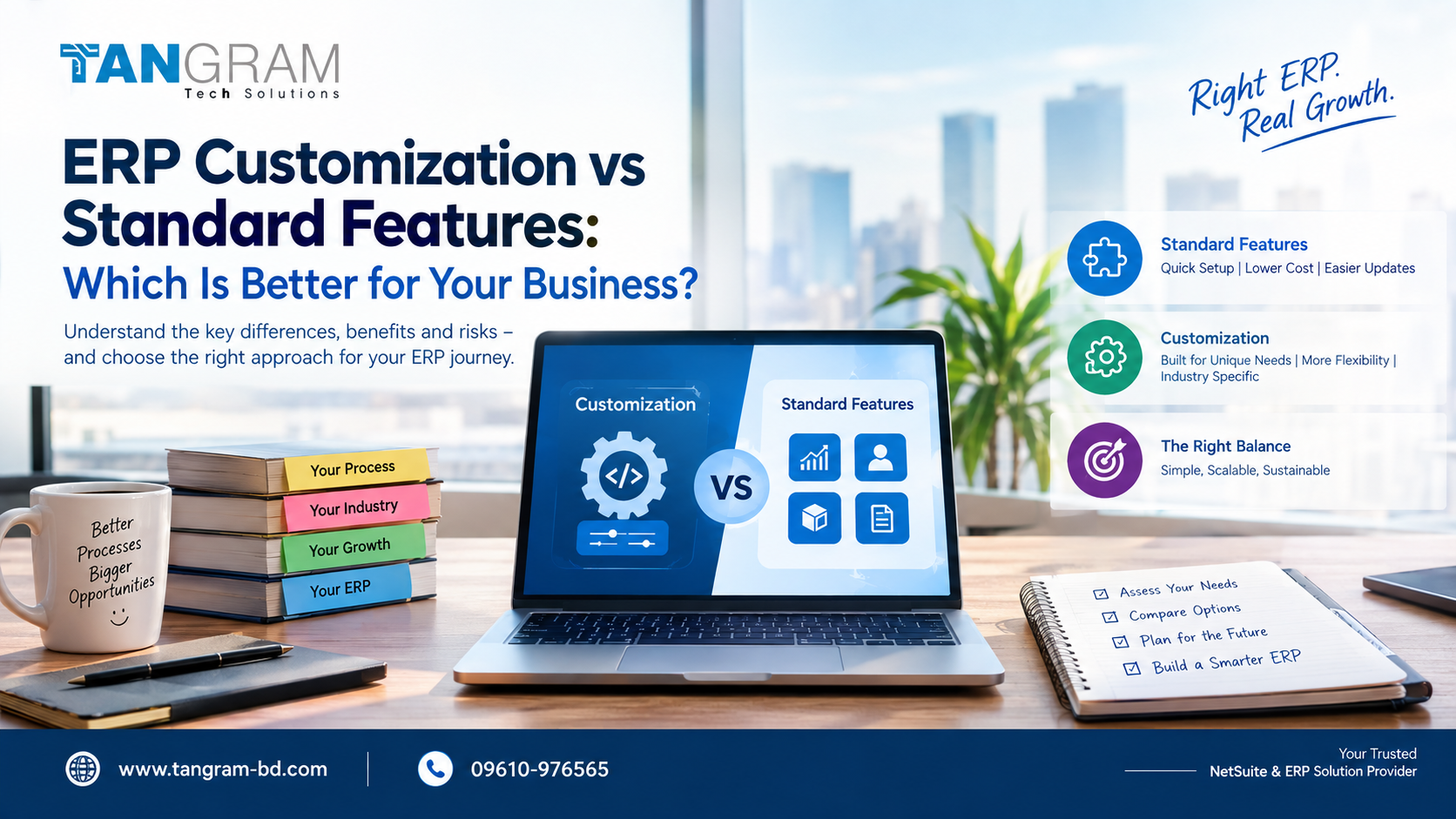
ERP Customization vs Standard Features: Which Is Better for Your Business?
Choosing an ERP system is not only about picking the right software. Businesses also need to think about how the system will fit into the way they work.
Some companies are happy to use the standard features that come with their ERP. Others need changes to handle specific processes or reporting requirements. The important thing is finding the right balance. Too much customization can make an ERP difficult to manage, while relying only on standard features may not always cover every business requirement.
For businesses in Bangladesh looking at ERP software, NetSuite, or NetSuite ERP Bangladesh, understanding when to use standard features and when customization makes sense can help control costs and keep the system practical.
What Are Standard ERP Features?
Standard ERP features are the functions already available within the software. Depending on the ERP, these may include finance, accounting, inventory, purchasing, sales, customer management, reporting, and workflow management.
In many cases, these features only need to be configured to match the business.
For example, a company may need an approval process for purchases. If the ERP already supports that workflow, the business may only need to configure the existing feature instead of developing something new.
Using standard features can also make implementation simpler because the business is working with functionality already provided by the ERP platform.
What Is ERP Customization?
ERP customization means changing or extending the system to meet a specific business requirement.
This could involve custom fields, forms, reports, dashboards, workflows, records, integrations, or additional development.
NetSuite provides several customization options, allowing businesses to adjust the system according to their processes.
For example, a company may have a particular approval process or reporting requirement that cannot be handled properly through the standard setup. In that situation, customization may be a practical solution.
When Should You Use Standard ERP Features?
Standard functionality is usually worth considering first when the ERP already provides what the business needs.
If a requirement can be handled through normal configuration, there may be little reason to build a custom solution. Keeping the system close to its standard functionality can make it easier to maintain and support in the future.
It can also reduce the amount of custom development required during implementation.
Before creating a customization, businesses should first check whether an existing ERP feature or configuration option can solve the problem.
When Does ERP Customization Make Sense?
Customization becomes useful when the standard system cannot properly support an important business requirement.
This could happen when a company has a unique process, specialized reporting needs, a complex approval structure, or a particular integration requirement.
For example, a business may have several internal approval stages that need to happen automatically. A standard workflow may handle part of the process, while additional customization may be needed for more complex requirements.
The important point is to customize for a genuine business need rather than simply trying to make the new ERP work exactly like an old system.
Why Too Much Customization Can Become a Problem
Customization is not necessarily a bad thing. The problem usually comes when changes are added without a clear reason.
A heavily customized ERP can require more development, testing, documentation, maintenance, and support. It may also become harder for employees to understand and use.
Another common issue is copying old processes into a new ERP without asking whether those processes are still necessary. If an old process was slow or inefficient, customizing the new system to follow it may simply carry the same problem forward.
Before customizing, businesses should ask whether the change will actually improve the way the business operates.
How to Decide Between Standard Features and Customization
A few simple questions can make the decision easier.
Does the ERP already provide this functionality?
Can the requirement be handled through configuration?
Is this requirement important enough to justify customization?
Will the customization make the process easier for employees?
How much will it cost to maintain in the future?
Could the business process change as the company grows?
Looking at these questions before development begins can help businesses avoid unnecessary complexity while still allowing customization where it provides real value.
ERP Customization for NetSuite in Bangladesh
Businesses searching for NetSuite in Bangladesh, NetSuite ERP Bangladesh, or NetSuite Business Solution Provider services should discuss their business processes before deciding what needs to be customized.
A practical implementation usually starts by understanding how the business operates, reviewing the standard NetSuite features, and then identifying the areas where configuration or customization is actually required.
Tangram Tech Solutions Ltd. provides NetSuite implementation, customization, integration, data migration, training, and ongoing support for businesses in Bangladesh.
Conclusion
Standard ERP features and customization do not have to be an either or decision. In many ERP projects, both approaches have a place.
The sensible approach is to use standard functionality when it meets the business requirement and introduce customization when there is a clear reason to do so.
The goal is not to create the most customized ERP system. The goal is to create a system that supports the business, remains manageable, and can continue to work as the company grows.
Website: https://www.tangram-bd.com/
Phone: 09610-976565