Choosing an ERP system is an important decision for any growing business. The right solution should make daily operations easier, give you a clearer picture of your finances and help your team manage business activities without unnecessary complications.
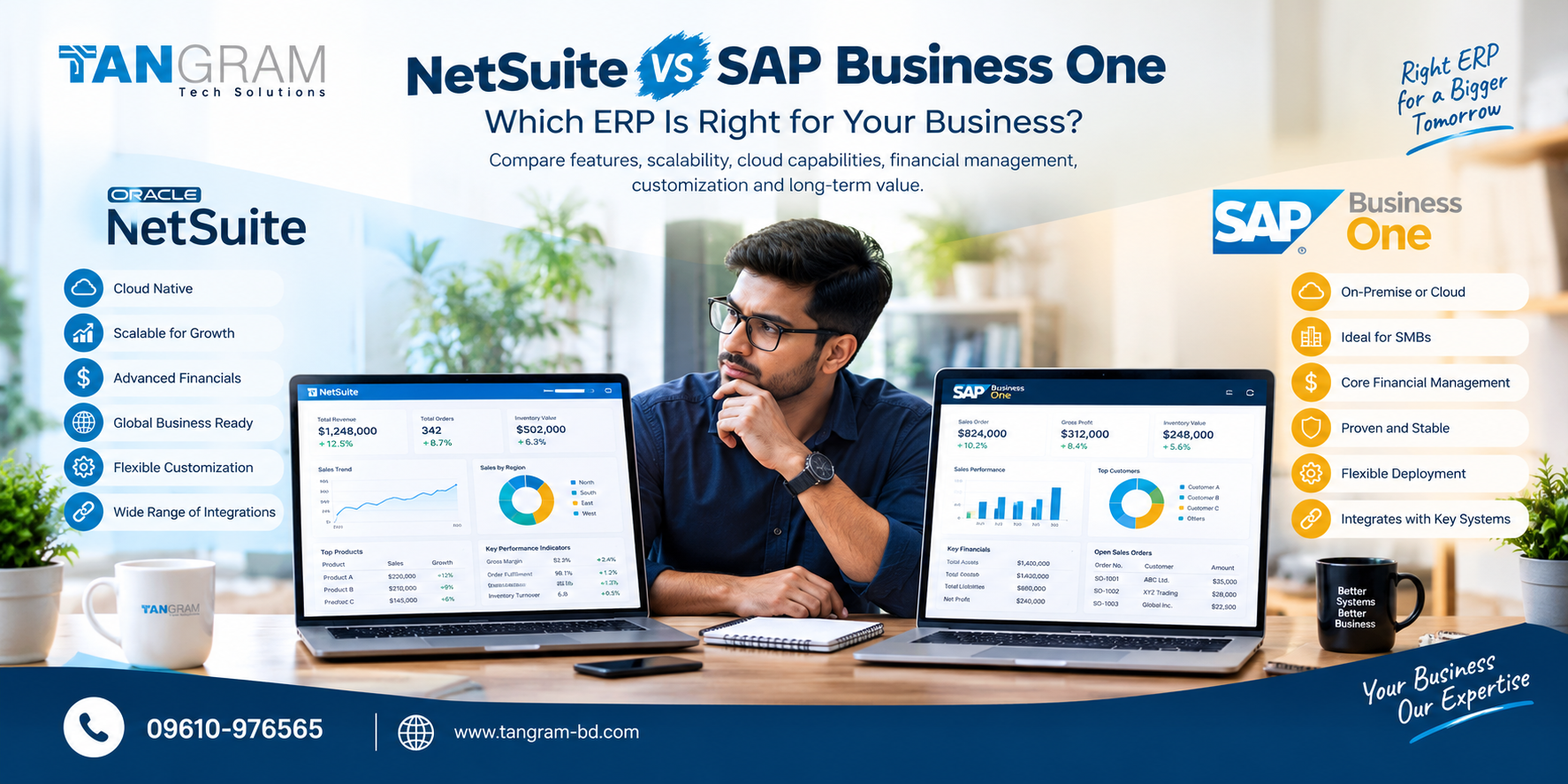
Oracle NetSuite and SAP Business One are two ERP solutions worth considering. Both help businesses manage areas such as accounting, inventory, sales, purchasing and reporting. However, they differ in how they are deployed, how they support business growth and how well they fit different operational needs.
If you are exploring NetSuite in Bangladesh or comparing ERP software in Bangladesh, understanding these differences can help you make a more confident decision.
1. Business Growth and Scalability
As a business grows, managing multiple departments, branches or subsidiaries can become more complicated. An ERP system should help keep these operations connected rather than create more work for your team.
Oracle NetSuite offers a cloud based platform that brings different business functions together. Its OneWorld capabilities are particularly useful for organizations managing multiple subsidiaries, currencies or international operations.
SAP Business One is designed mainly for small and midsize businesses. It brings core business activities into one system and can also support subsidiaries of larger organizations.
Which is the better fit?
If your company plans to expand into new markets, manage several subsidiaries or handle increasingly complex operations, NetSuite may be worth a closer look. If your business needs an integrated system for its current finance, sales, purchasing and inventory processes, SAP Business One may be a suitable option.
2. Cloud Capabilities and Deployment
Where and how your ERP system operates can affect accessibility, maintenance and IT responsibilities.
NetSuite is a cloud based ERP solution. It allows businesses to manage connected financial and operational information through a single platform, without requiring them to maintain the core ERP infrastructure themselves.
SAP Business One offers different deployment options, including on premises and cloud based arrangements, depending on the solution and hosting setup.
The best choice depends on your company’s working environment. Consider whether employees need access from different locations, how much control your IT team requires and what level of maintenance your business can manage.
Rather than focusing only on cloud versus on premises deployment, look at the overall experience your team will have when using the system every day.
3. Financial Management and Reporting
Reliable financial information helps business owners make better decisions. When accounting data is spread across separate tools, preparing reports and understanding the company’s financial position can take more time than necessary.
NetSuite supports accounting, accounts payable and receivable, budgeting, financial reporting and financial consolidation. Its connected platform also brings financial information together with business activities such as inventory and order management.
SAP Business One includes financial management features such as accounting, banking, budgeting, fixed asset management, financial reporting and analysis.
Both systems can support important financial processes, but the right choice depends on how your company manages its accounts.
Before deciding, consider your reporting requirements, approval workflows, budgeting process and month end closing activities. A practical demonstration using your actual business scenarios will tell you more than a long list of features.
4. Customization and Integrations
No two businesses operate in exactly the same way. You may need specific reports, approval processes, additional fields or connections with the software your team already uses.
Both NetSuite and SAP Business One offer ways to adapt and extend their capabilities. However, the work involved will depend on your requirements, the available tools and the implementation approach.
Start by identifying the systems your ERP needs to connect with. These might include an ecommerce platform, CRM software, banking tools or other applications used by your team.
Ask potential implementation partners how each integration will work, whether additional customization is required and what ongoing maintenance may cost. Addressing these questions early can help prevent unexpected expenses later.
5. Cost and Long Term Business Needs
ERP costs involve more than the initial software price. Implementation, customization, data migration, employee training, integrations and ongoing support can all contribute to the total investment.
A solution with a lower initial cost may require additional work to meet your business requirements. On the other hand, a more extensive platform may include capabilities your company does not need yet.
That is why comparing software prices alone can be misleading.
Prepare a realistic budget that includes both the initial implementation and the expected costs of using the system over time. Consider how your requirements may change as your business grows.
The goal is not simply to choose the cheapest ERP. It is to invest in a system that provides practical value without paying for functionality your business will rarely use.
Which ERP Should You Choose?
The right choice depends on your business size, operational complexity, budget and future plans.
Consider NetSuite if your business needs a cloud based ERP platform, connected business processes or support for multiple subsidiaries and international operations.
Consider SAP Business One if your company is looking for an integrated solution for core financial, sales, purchasing and inventory activities, particularly within a small or midsize business environment.
These are general guidelines, not fixed rules. The most suitable system will depend on your specific requirements and how each solution can meet them.
For businesses considering NetSuite ERP Bangladesh, working with an experienced implementation partner can make the evaluation process easier. Tangram Tech Solutions provides NetSuite implementation, customization, integration, data migration, training and ongoing support to help businesses plan and manage their ERP projects.
Conclusion
Choosing between NetSuite and SAP Business One is about more than comparing features. It is about understanding how your business operates today and what it will need in the years ahead.
Take time to document your requirements, compare the total implementation costs and request demonstrations based on real business scenarios. Involve the people who will use the system every day, as their feedback can reveal practical needs that are easy to overlook.
With the right planning and implementation support, your ERP investment can help improve visibility, organize business processes and support sustainable growth.
Looking for NetSuite ERP solutions in Bangladesh?
Visit www.tangram-bd.com to learn more about Tangram Tech Solutions and its ERP services.
Telephone: 09610-976565
NetSuite vs SAP Business One: Which ERP Is Right for Your Business?
Choosing an ERP system is an important decision for any growing business. The right solution should make daily operations easier, give you a clearer picture of your finances and help your team manage business activities without unnecessary complications.
Oracle NetSuite and SAP Business One are two ERP solutions worth considering. Both help businesses manage areas such as accounting, inventory, sales, purchasing and reporting. However, they differ in how they are deployed, how they support business growth and how well they fit different operational needs.
If you are exploring NetSuite in Bangladesh or comparing ERP software in Bangladesh, understanding these differences can help you make a more confident decision.
1. Business Growth and Scalability
As a business grows, managing multiple departments, branches or subsidiaries can become more complicated. An ERP system should help keep these operations connected rather than create more work for your team.
Oracle NetSuite offers a cloud based platform that brings different business functions together. Its OneWorld capabilities are particularly useful for organizations managing multiple subsidiaries, currencies or international operations.
SAP Business One is designed mainly for small and midsize businesses. It brings core business activities into one system and can also support subsidiaries of larger organizations.
Which is the better fit?
If your company plans to expand into new markets, manage several subsidiaries or handle increasingly complex operations, NetSuite may be worth a closer look. If your business needs an integrated system for its current finance, sales, purchasing and inventory processes, SAP Business One may be a suitable option.
2. Cloud Capabilities and Deployment
Where and how your ERP system operates can affect accessibility, maintenance and IT responsibilities.
NetSuite is a cloud based ERP solution. It allows businesses to manage connected financial and operational information through a single platform, without requiring them to maintain the core ERP infrastructure themselves.
SAP Business One offers different deployment options, including on premises and cloud based arrangements, depending on the solution and hosting setup.
The best choice depends on your company’s working environment. Consider whether employees need access from different locations, how much control your IT team requires and what level of maintenance your business can manage.
Rather than focusing only on cloud versus on premises deployment, look at the overall experience your team will have when using the system every day.
3. Financial Management and Reporting
Reliable financial information helps business owners make better decisions. When accounting data is spread across separate tools, preparing reports and understanding the company’s financial position can take more time than necessary.
NetSuite supports accounting, accounts payable and receivable, budgeting, financial reporting and financial consolidation. Its connected platform also brings financial information together with business activities such as inventory and order management.
SAP Business One includes financial management features such as accounting, banking, budgeting, fixed asset management, financial reporting and analysis.
Both systems can support important financial processes, but the right choice depends on how your company manages its accounts.
Before deciding, consider your reporting requirements, approval workflows, budgeting process and month end closing activities. A practical demonstration using your actual business scenarios will tell you more than a long list of features.
4. Customization and Integrations
No two businesses operate in exactly the same way. You may need specific reports, approval processes, additional fields or connections with the software your team already uses.
Both NetSuite and SAP Business One offer ways to adapt and extend their capabilities. However, the work involved will depend on your requirements, the available tools and the implementation approach.
Start by identifying the systems your ERP needs to connect with. These might include an ecommerce platform, CRM software, banking tools or other applications used by your team.
Ask potential implementation partners how each integration will work, whether additional customization is required and what ongoing maintenance may cost. Addressing these questions early can help prevent unexpected expenses later.
5. Cost and Long Term Business Needs
ERP costs involve more than the initial software price. Implementation, customization, data migration, employee training, integrations and ongoing support can all contribute to the total investment.
A solution with a lower initial cost may require additional work to meet your business requirements. On the other hand, a more extensive platform may include capabilities your company does not need yet.
That is why comparing software prices alone can be misleading.
Prepare a realistic budget that includes both the initial implementation and the expected costs of using the system over time. Consider how your requirements may change as your business grows.
The goal is not simply to choose the cheapest ERP. It is to invest in a system that provides practical value without paying for functionality your business will rarely use.
Which ERP Should You Choose?
The right choice depends on your business size, operational complexity, budget and future plans.
Consider NetSuite if your business needs a cloud based ERP platform, connected business processes or support for multiple subsidiaries and international operations.
Consider SAP Business One if your company is looking for an integrated solution for core financial, sales, purchasing and inventory activities, particularly within a small or midsize business environment.
These are general guidelines, not fixed rules. The most suitable system will depend on your specific requirements and how each solution can meet them.
For businesses considering NetSuite ERP Bangladesh, working with an experienced implementation partner can make the evaluation process easier. Tangram Tech Solutions provides NetSuite implementation, customization, integration, data migration, training and ongoing support to help businesses plan and manage their ERP projects.
Conclusion
Choosing between NetSuite and SAP Business One is about more than comparing features. It is about understanding how your business operates today and what it will need in the years ahead.
Take time to document your requirements, compare the total implementation costs and request demonstrations based on real business scenarios. Involve the people who will use the system every day, as their feedback can reveal practical needs that are easy to overlook.
With the right planning and implementation support, your ERP investment can help improve visibility, organize business processes and support sustainable growth.
Looking for NetSuite ERP solutions in Bangladesh?
Visit www.tangram-bd.com to learn more about Tangram Tech Solutions and its ERP services.
Telephone: 09610-976565