
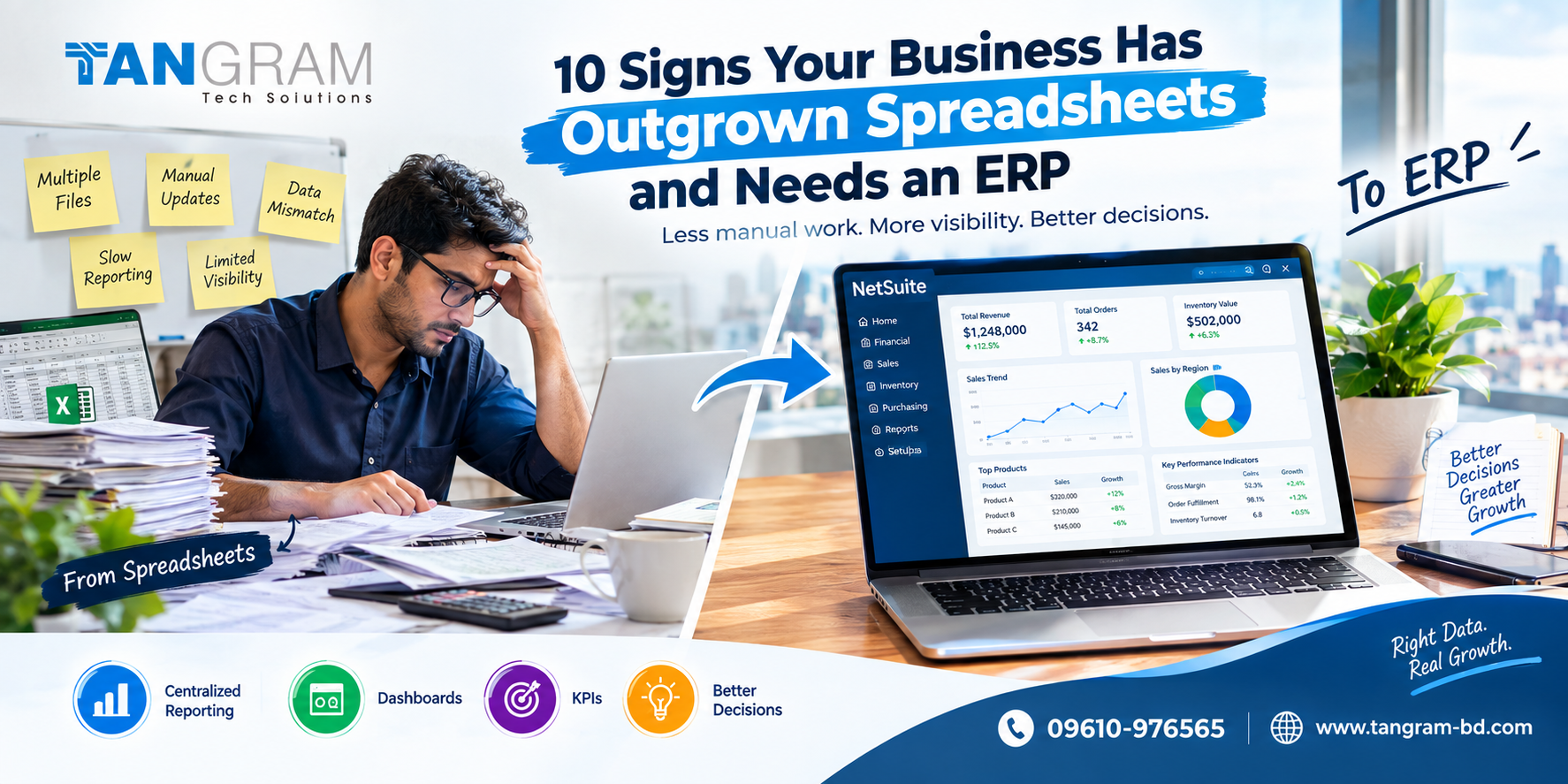
10 Signs Your Business Has Outgrown Spreadsheets and Needs an ERP
As a business grows, spreadsheets often become part of everyday work. They are easy to start with, flexible and useful for keeping track of basic information.
But there comes a point when spreadsheets are no longer enough.
More customers, more products, more employees, multiple departments and increasing transaction volumes can make spreadsheet based processes difficult to manage. Information may be stored in different files, employees may use different versions of the same data, and management may struggle to get a clear picture of what is happening.
For businesses in Bangladesh searching for ERP, ERP software, NetSuite in Bangladesh or NetSuite ERP Bangladesh, knowing when spreadsheets have reached their limit can help identify the right time to consider an ERP system.
Sign One: Your Business Depends on Too Many Spreadsheets
If different departments maintain separate spreadsheets for sales, inventory, purchasing, finance and customers, managing information can become complicated.
Employees may spend a significant amount of time updating files and checking whether they are working with the latest version.
An ERP system brings these business activities together in one connected environment.
Sign Two: You Keep Entering the Same Information
Entering the same customer, product or transaction information into multiple files is not an efficient way to manage a growing business.
It also increases the possibility of mistakes.
When information is entered into an ERP system, connected processes can use that information without requiring employees to repeatedly enter the same details.
Sign Three: Management Cannot Get Information Quickly
A growing business needs timely information.
If management has to wait for employees to collect data from several spreadsheets before answering a simple question about sales, inventory, expenses or outstanding payments, the current system may be holding the business back.
ERP reporting and dashboards can provide management with a more organized view of business performance.
Sign Four: Inventory Information Is Becoming Difficult to Trust
Inventory becomes more difficult to manage as the number of products, warehouses and orders increases.
If employees regularly find differences between spreadsheet records and actual stock, or if the business experiences frequent stockouts and excess inventory, it may be time to rethink the way inventory is managed.
An ERP system can connect inventory with purchasing, sales and other business processes.
Sign Five: Errors Are Becoming More Common
Spreadsheets depend heavily on manual data entry and human checking.
A misplaced formula, incorrect figure or outdated file can affect other calculations and reports. As the business becomes more complex, these small mistakes can have a larger impact.
ERP systems can reduce repetitive manual work by connecting processes and applying defined workflows.
Sign Six: Different Departments Have Different Numbers
When sales, finance and management use separate files, it is possible for each department to have a different version of the same information.
This makes it difficult to know which figure is correct.
A centralized ERP system gives departments access to connected business information, helping create a more consistent view of company performance.
Sign Seven: Closing Accounts Takes Too Long
If the finance team spends too much time collecting information from different spreadsheets before completing financial reporting, the process can become a burden.
As transaction volumes increase, businesses often need a more structured way to manage financial information and connect it with other operations.
This is one area where ERP can provide significant value.
Sign Eight: Your Business Is Using Too Many Disconnected Tools
Spreadsheets are often joined by separate accounting software, CRM tools, inventory applications and other systems.
When these tools do not communicate properly, employees may have to move information manually from one system to another.
ERP integration can bring important business processes together and reduce unnecessary movement of information between systems.
Sign Nine: Your Team Is Spending More Time Managing Data Than Using It
Data should help employees do their jobs, not become a job by itself.
If employees spend hours preparing spreadsheets, checking information, copying data and creating manual reports, valuable time is being spent maintaining the system rather than improving the business.
This is often a strong indication that the company has reached a point where automation and centralized information are needed.
Sign Ten: The Business Is Growing Faster Than Its Current Systems
Perhaps the clearest sign is growth itself.
When a business adds new employees, products, branches, customers or business processes, the systems that worked well when the company was smaller may no longer be practical.
This is where ERP software can become the next logical step.
An ERP system can connect finance, inventory, purchasing, sales, customer management, reporting and other operations within one business environment.
When Should a Business Move From Spreadsheets to ERP?
There is no specific company size that determines when a business needs ERP.
The better question is whether the current system is still supporting the way the business operates.
If employees are constantly fixing spreadsheet errors, management cannot get information quickly, departments are working with different data, or manual processes are slowing growth, it may be time to consider an ERP solution.
For businesses looking for NetSuite in Bangladesh, NetSuite ERP Bangladesh or a NetSuite Business Solution Provider, Oracle NetSuite can provide a connected platform for managing financials, inventory, sales, purchasing, reporting and other business processes.
Tangram Tech Solutions provides NetSuite implementation, customization, integration, data migration, training and ongoing support for businesses looking to move toward a more connected ERP environment.
Conclusion
Spreadsheets are not bad tools. They can be extremely useful when a business is small and its processes are relatively simple.
The problem begins when the business grows beyond what spreadsheets can comfortably handle.
If information is scattered, processes are heavily manual, reporting takes too long and management does not have a clear view of the business, these are signs worth paying attention to.
For a growing business, moving from spreadsheets to ERP software is not simply about replacing Excel. It is about creating a more connected way of managing information, processes and day to day operations.
Website: www.tangram-bd.com
Tele: 09610-976565