
For many growing businesses, the problem is not sales. The problem is getting paid on time. Invoices go out late, follow-ups depend on someone’s memory, and the finance team spends days building an aging report in Excel that is already out of date when it is finished. Every extra day a customer takes to pay is cash your business cannot use for salaries, stock or growth.
NetSuite Accounts Receivable is designed to fix exactly this. As part of Oracle NetSuite, the leading cloud ERP, it connects invoicing, collections, customer credit and reporting in one system. Below are eight practical benefits of NetSuite Accounts Receivable and what they mean for businesses using ERP in Bangladesh.
What Is NetSuite Accounts Receivable?
NetSuite Accounts Receivable is the part of the NetSuite ERP financial management suite that handles everything from the customer invoice to the final payment: billing, payment terms, credit limits, reminders, cash application and AR reporting. You can read Oracle’s own overview of NetSuite accounts receivable software. Unlike a standalone accounting tool, it shares the same live data as sales, inventory and the general ledger.
1. Faster, More Accurate Invoicing
In NetSuite, an invoice can be created directly from a sales order, an item fulfillment, a billing schedule or project time. Prices, discounts, tax codes and payment terms come from the customer and item records, so the team does not type them again. This means fewer billing mistakes, fewer disputes, and invoices that reach the customer on the same day the goods or services are delivered. The sooner an invoice goes out, the sooner the payment clock starts.
2. Real-Time AR Aging and Customer Balances
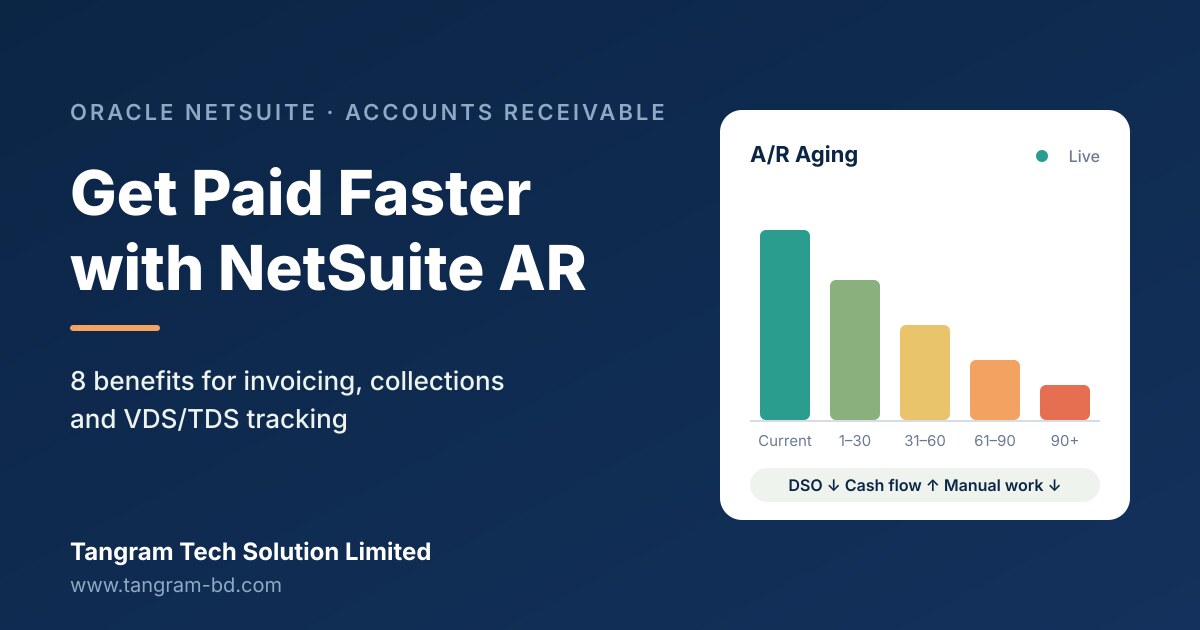
NetSuite’s A/R Aging report is always live. You can see the total amount outstanding, split into buckets such as current, 1–30, 31–60, 61–90 and over 90 days, and then drill down from the total to a single customer and a single invoice in a few clicks. There is no need to export, filter and rebuild a spreadsheet every Monday morning. Managers can also add AR key performance indicators (KPIs) and reminders to their dashboard, so overdue balances are visible the moment they log in.
3. Automated Payment Reminders (Dunning)
Chasing payments by phone and manual email is time-consuming and inconsistent. With NetSuite’s Dunning Letters SuiteApp, you can set rules that automatically send reminder emails based on how many days an invoice is overdue. The first message can be a friendly reminder, the next one firmer, and the final one a formal notice. Different rules can apply to different customer groups. Every letter sent is recorded on the customer record, so the whole team knows the collection history.
4. Better Credit Control
Selling to a customer who already has large unpaid bills increases your risk. NetSuite lets you set a credit limit and payment terms for each customer. When a new sales order would push the customer over the limit, the system can warn the user or stop the transaction, depending on your preference. Customers can also be placed on credit hold. This helps the sales and finance teams work from the same rules instead of arguing case by case.
5. Simple Payment Application and Reconciliation
When a customer pays, the receipt can be applied to one or many open invoices, including partial payments, deposits, and credit memos. With bank feeds and the bank reconciliation tools, incoming payments can be matched against open transactions much faster than in a manual ledger. The result is a cleaner customer ledger and fewer “unapplied payment” surprises at month-end. You can see more examples in our guide to business processes you can automate with NetSuite.
6. Handling VDS and TDS Deductions (Bangladesh Context)
In Bangladesh, many customers deduct VAT at source (VDS) and tax at source (TDS) before paying an invoice. If these deductions are not tracked properly, the customer balance never fully closes and the finance team cannot tell whether the gap is a real shortfall or a pending deduction certificate (challan). With the right configuration, NetSuite can record the deducted amounts against each invoice, track which deduction certificates have been received, and report outstanding certificates by customer, sales executive or area. This turns a monthly headache into a clear, controlled process.
7. Customer Statements and Self-Service
NetSuite can generate customer statements in bulk and send them by email, so customers always know what they owe. With add-ons such as NetSuite’s online payment options and a customer self-service portal, customers can view their invoices and pay online. Making it easy to pay is one of the simplest ways to get paid faster.
8. Reliable Month-End Close and Reporting
Because the AR subledger and the general ledger live in the same system, there is no separate upload or reconciliation between them. The AR control account always agrees with the aging report. Reports such as Days Sales Outstanding (DSO), collection performance and bad-debt exposure can be built with saved searches and shared with management in real time. The month-end close becomes faster and much easier to audit. For ideas on which numbers to track, see ERP dashboards and KPIs for business leaders.
How NetSuite Accounts Receivable Improves Cash Flow
When invoices go out faster, reminders go out automatically and payments are applied correctly, the result is a lower DSO and more predictable cash flow. Finance staff also spend less time on data entry and more time on the customers and invoices that really need attention. Read more about how ERP improves cash flow for growing businesses.
| Common AR problem | How NetSuite helps |
|---|---|
| Late or incorrect invoices | Invoices created from sales orders and billing schedules |
| Outdated Excel aging reports | Live A/R aging with drill-down |
| Forgotten follow-ups | Rule-based automated dunning emails |
| Bad debts from risky customers | Credit limits and credit hold |
| Unclear VDS/TDS shortfalls | Deduction and certificate tracking per invoice |
| Slow month-end close | AR and GL in one system |
Getting Started with NetSuite Accounts Receivable in Bangladesh
NetSuite’s AR tools deliver the most value when they are configured around your real business process: your payment terms, your customer groups, your approval rules, and your local tax requirements. As an official Oracle NetSuite partner in Bangladesh, Tangram Tech Solution Limited helps businesses set up and optimise NetSuite Accounts Receivable, from invoicing and dunning to VDS/TDS tracking and management reporting.
Want to reduce your collection time and get a clear view of every taka your customers owe? Contact Tangram today to discuss how NetSuite can improve your receivables process.