
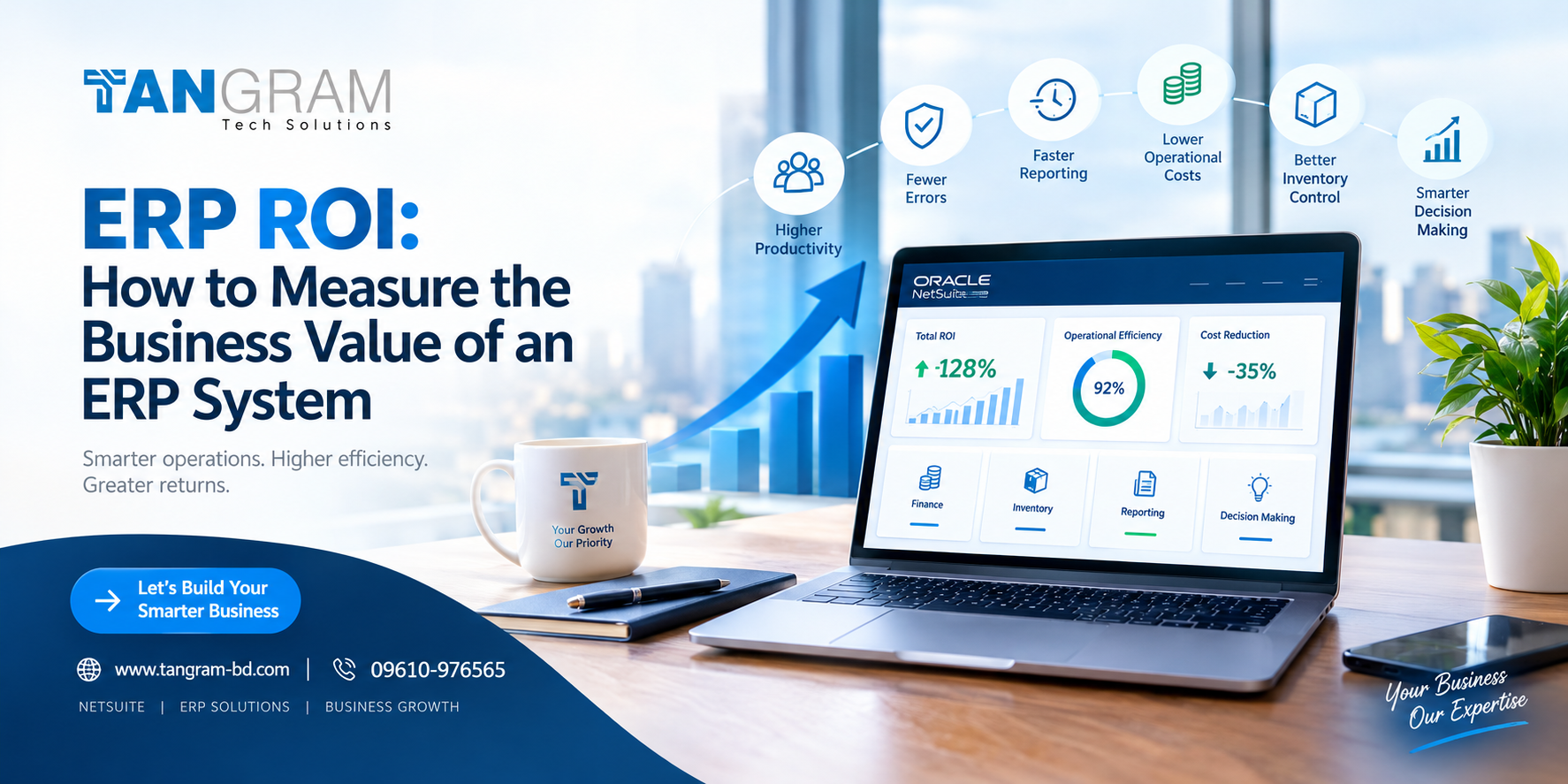
ERP ROI: How to Measure the Business Value of an ERP System
Choosing an ERP system is a major investment for any business. Before making that decision, business owners want to know one thing: will the investment actually pay off?
ERP return on investment (ROI) helps answer this question by showing how much value a business gains compared with the cost of implementing and maintaining the system.
For businesses in Bangladesh, ERP software can help reduce manual work, improve financial reporting, manage inventory and control operating expenses. Solutions such as NetSuite ERP bring key business processes together, helping management understand what is happening across the organization.
What Is ERP ROI?
ERP ROI measures the financial benefits a business receives from its ERP system compared with the total cost of the investment. These benefits can include time savings, fewer errors, lower operating costs and more efficient use of resources.
The basic formula is:
ERP ROI (%) = [(Total Benefits − Total Costs) ÷ Total Costs] × 100
For example, suppose a company gains ৳20 lakh in measurable benefits over a year and spends ৳10 lakh on its ERP system during the same period. Its ROI would be 100%.
The actual return depends on the company’s needs, implementation costs and how effectively the system is used.
Five Ways to Measure ERP Business Value
1. Employee Productivity
Think about how much time your employees spend entering data, updating spreadsheets and preparing routine reports. These tasks can take hours that could be spent on more valuable work.
An ERP system can automate many repetitive activities and reduce duplicate data entry. To measure the improvement, compare the time employees spend on these tasks before and after implementation. The hours saved can help you estimate the financial value of increased productivity.
2. Fewer Errors and Lower Costs
Manual processes can lead to incorrect entries, duplicate records and costly mistakes. Correcting these problems takes time and may affect other departments.
ERP software helps keep business information consistent across departments, reducing the need for repeated data entry. Compare error rates, correction expenses and administrative costs before and after implementation to see where savings are being made.
3. Faster Financial Reporting
When financial data is spread across multiple systems, preparing accurate reports can become a lengthy process. Management may have to wait for information before making important decisions.
With an integrated ERP system, finance teams can access connected business data more easily. Track how long it takes to prepare monthly reports, reconcile accounts and close the books. Shorter reporting cycles can help management respond to changes more quickly.
4. Better Inventory Control
Too much inventory ties up cash, while too little can lead to missed sales and delayed deliveries. Both situations can affect profitability.
ERP inventory management helps businesses monitor stock levels, purchasing and product movements. Useful measures include inventory accuracy, stockout frequency, inventory turnover and storage costs. Reviewing these figures can show whether inventory management is improving.
5. Better Business Decisions
Good decisions depend on reliable information. When sales, finance, purchasing and inventory data are easier to access, managers can make more informed decisions about budgets, demand and resource allocation.
You can measure improvements through forecast accuracy, budget performance and planning efficiency. Although not every benefit can be measured directly in money, better decisions can make a meaningful difference to long term business growth.
What Does an ERP System Really Cost?
The cost of an ERP system goes beyond the software subscription. Businesses should also consider implementation, customization, data migration, employee training, integration, support and ongoing maintenance.
It is equally important to account for the time employees need to learn the system and adjust to new workflows. Including these expenses gives you a more realistic picture of the investment and its potential return.
Is NetSuite ERP Suitable for Your Business in Bangladesh?
Businesses looking to improve financial management, inventory visibility and operational efficiency may consider NetSuite ERP. Its suitability depends on the company’s size, industry, business processes and future plans.
Before choosing a solution, identify the problems you want to solve and set clear targets for improvement. Working with an experienced implementation partner can also help you select the right approach, prepare your team and track results after the system goes live.
Make Your ERP Investment Count
An ERP system should deliver more than new technology. Its real value comes from measurable improvements in productivity, cost control, reporting and everyday business operations.
Tangram Tech Solutions Ltd. helps businesses explore ERP solutions that fit their operational needs. If you are considering NetSuite in Bangladesh, start by identifying your business goals and the results you want your ERP investment to deliver.
Website: https://www.tangram-bd.com/
Telephone: 09610-976565