
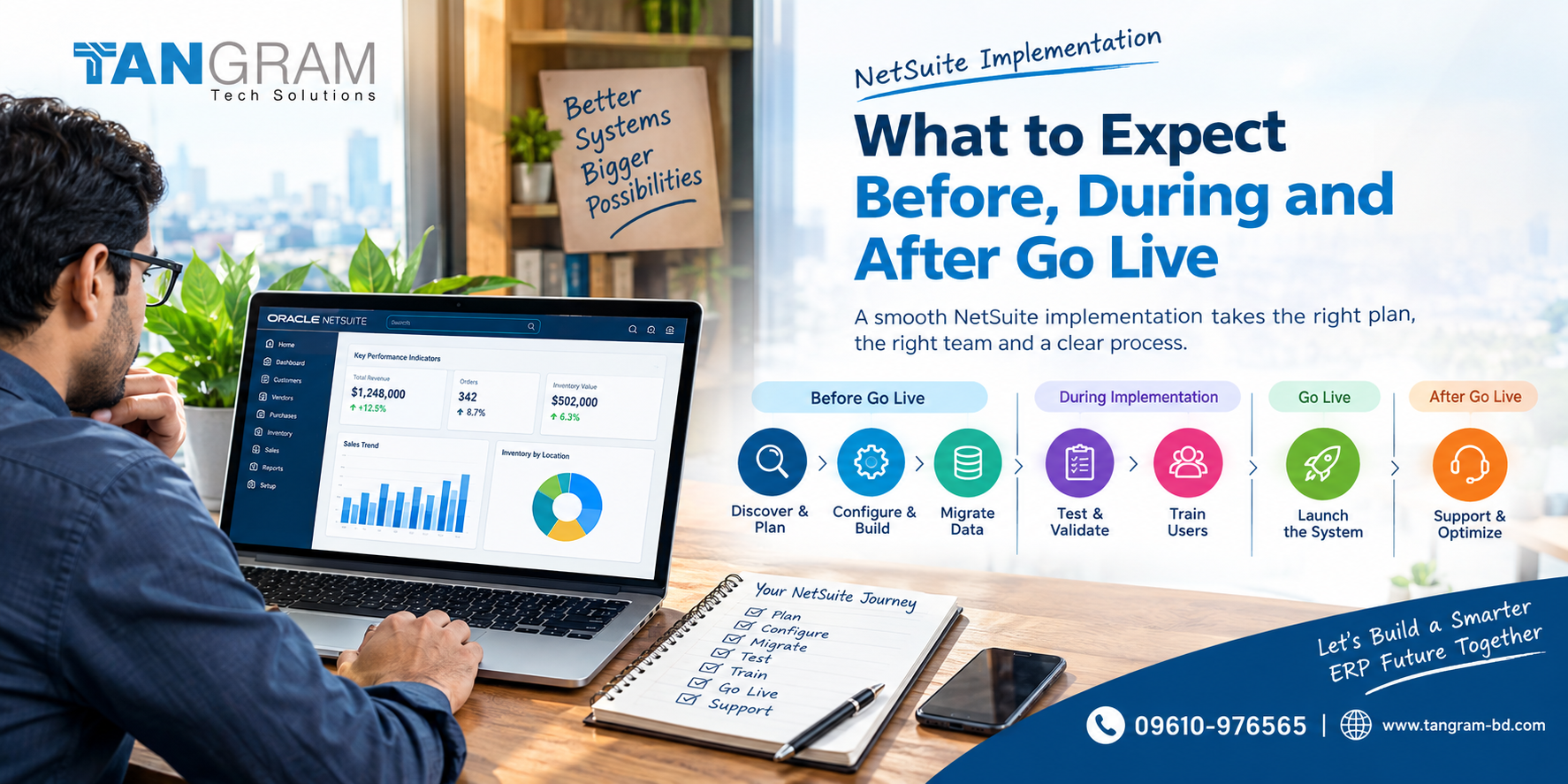
NetSuite Implementation: What to Expect Before, During and After Go Live
Choosing NetSuite is only the beginning. The real work starts when a business begins preparing the system around its people, processes, data and day to day operations.
A successful NetSuite implementation involves much more than setting up new software. Businesses need to understand how their current operations work, identify what the new system needs to support, prepare existing data, configure the required features, test important processes and make sure employees are ready before the system goes live.
For businesses in Bangladesh considering NetSuite, ERP software, NetSuite in Bangladesh or NetSuite ERP Bangladesh, having a clear understanding of the implementation process can make the transition much easier to manage.
What Happens Before NetSuite Go Live?
The early stage of a NetSuite implementation is mainly about understanding the business.
The implementation team needs to look at how different departments currently operate, what information they use, which reports management needs, what systems are already in place and where improvements are needed. This helps create a clear picture of how NetSuite should support the business.
At Tangram, this stage involves discovery, scoping and solution architecture. Once the business requirements are understood, the next step is to design and configure the system around those requirements.
Data preparation is another important part of the early stage. Customer information, supplier records, products, inventory, financial information and other relevant data may need to be reviewed, cleaned and organized before being transferred into NetSuite.
Taking the time to prepare data properly can reduce migration issues and make the transition smoother.
What Happens During NetSuite Implementation?
Once the requirements and system design have been agreed upon, the implementation moves into configuration and development.
Depending on the business, this may include financial management, inventory, purchasing, sales, user roles, approvals, reports, dashboards and workflows. The system is configured to support the processes employees use in their daily work.
Some businesses may also need integrations with other applications or specific customizations. These requirements can be addressed during implementation so that NetSuite works effectively with the company’s existing systems.
Data migration is another major part of the project. Existing business information needs to be transferred into NetSuite in an organized and structured way. The approach can vary depending on the type, quality and volume of data involved.
The goal is not simply to move everything from the old system. The focus should be on bringing the right information into NetSuite in a clean, accurate and usable format.
Testing Before Go Live
Testing is one of the most important stages of a NetSuite implementation.
Instead of only checking whether individual features work, the system should be tested using real business scenarios. For example, the team may test purchasing, sales orders, invoicing, inventory movements, payments, approvals and management reporting.
User Acceptance Testing, commonly known as UAT, is particularly important.
During UAT, actual users can work through common business scenarios in a controlled testing environment. This gives them an opportunity to identify problems, provide feedback and become familiar with the new system before they start using it in their daily work.
Finding and fixing an issue during testing is much easier than discovering the same problem after go live.
User Training and Go Live Preparation
Even a well configured ERP system depends on the people who use it.
Training should therefore be relevant to each user’s responsibilities. Finance employees may use different areas of NetSuite compared with sales, purchasing, inventory or management teams.
Before going live, the business and implementation team should also review the key areas of the system. User access, permissions, migrated data, integrations, reports and workflows should all be checked to reduce unnecessary problems during the transition.
Employees should also have a clear understanding of their new processes and responsibilities before they begin working in the live system.
Tangram’s implementation approach includes user training, go live support and post go live assistance, helping businesses move from their existing systems to NetSuite with greater confidence.
What Happens After Go Live?
Going live does not mean the implementation journey is completely finished.
Once employees begin using NetSuite for their everyday activities, new questions and requirements may appear. A report may need to be adjusted, a user may need additional guidance or a workflow may need some refinement.
This is where post go live support becomes important.
As the business grows, it may also add new employees, introduce new processes, connect additional applications or start using more NetSuite functionality. The system can then continue to be improved based on the company’s changing requirements.
A good implementation should provide the business with a strong foundation while allowing the ERP system to develop alongside its future needs.
NetSuite Implementation in Bangladesh
For businesses searching for NetSuite in Bangladesh, NetSuite ERP Bangladesh or a NetSuite Business Solution Provider, choosing the right implementation partner is an important part of the project.
An implementation partner should take the time to understand how the business operates rather than simply applying a standard configuration. Every company has different processes, reporting requirements, users and operational challenges.
The implementation should start with those business requirements and then determine how NetSuite can be configured to support them effectively.
Tangram Tech Solutions has been providing Oracle NetSuite ERP solutions since 2021. Its services include NetSuite implementation, customization, integration, data migration, optimization, training and ongoing support. Tangram also states that its team includes certified NetSuite consultants and developers with ERP development and consulting experience.
Conclusion
A NetSuite implementation involves much more than setting up an ERP system.
Discovery, system design, data preparation, configuration, data migration, testing, training, go live and post go live support all play an important role in the overall implementation process.
The better a business understands its requirements before the project begins, the easier it becomes to prepare its people, data and processes for the transition.
For businesses considering NetSuite ERP in Bangladesh, a well planned implementation can provide a strong foundation for managing current operations while giving the business the flexibility to grow and adapt as its requirements change.
Website: www.tangram-bd.com
Phone: 09610 976565
