Business Transformation with ERP: Is Your Business Ready?
Business transformation is no longer something companies can simply plan for in the distant future. As customer expectations change and competition continues to grow, businesses need to find better ways to manage their daily operations, serve customers, and control costs.
For many companies, the challenge is not a lack of effort. The problem is that the tools they use are no longer keeping up with the business.
A company may still depend on spreadsheets for finance, separate software for sales, another system for inventory, and emails or paper records for other processes. These methods can work when the business is small. But as operations become more complicated, managing everything this way can create unnecessary work.
Information may be entered more than once. Reports can take longer to prepare. Different departments may work with different versions of the same information. Small delays can also make it harder for management to understand what is happening across the business.
This is where Enterprise Resource Planning (ERP) can make a real difference.
Why Businesses Are Moving Toward ERP
An ERP system brings important business activities into one connected environment.
Instead of keeping finance, sales, inventory, purchasing, customer information, and other operations completely separate, an ERP can connect these areas and allow information to move between them.
For example, when a customer places an order, the relevant information can be connected with inventory, fulfillment, and financial processes. Employees do not have to keep checking different systems to understand what happened.
This can reduce repetitive work and give teams a clearer view of the business.
Signs Your Business May Be Ready for ERP
Not every company needs an ERP system immediately. However, certain problems can indicate that the existing way of working is becoming difficult to maintain.
Your Business Is Using Too Many Separate Systems
If your finance team uses one system, sales uses another, inventory is managed somewhere else, and employees regularly move information between them, it may be time to consider a more connected approach.
The more systems a business uses, the more important it becomes to make sure those systems work together properly.
Your Team Relies Heavily on Spreadsheets
Spreadsheets can be extremely useful, but they can also become difficult to manage when a business grows.
Multiple files, manual updates, formulas, and different versions of the same report can create confusion.
An ERP system can provide a central place for important business information and reduce the need for repetitive manual updates.
Management Cannot Get Information Quickly
Business decisions often depend on accurate and timely information.
If management has to wait for different departments to prepare reports before understanding sales, inventory, expenses, or financial performance, decisions can take longer.
ERP systems can provide dashboards and reporting tools that make important information easier to access.
Employees Spend Too Much Time on Manual Work
If employees regularly copy information from one system to another, prepare reports manually, or repeatedly enter the same data, valuable working time is being lost.
ERP automation can help reduce repetitive tasks and allow employees to spend more time on work that requires human attention.
Business Operations Are Becoming More Complicated
Growth is a positive thing, but it also creates new challenges.
More customers, products, suppliers, employees, locations, and transactions can make existing systems harder to manage.
An ERP system can provide a more organized foundation for managing these growing operations.
How ERP Supports Business Transformation
ERP is not simply about replacing old software.
The bigger opportunity is improving how the business works.
When information is connected, departments can collaborate more easily. Finance can see information related to sales and purchasing. Inventory teams can work with current stock information. Management can access reports without waiting for information to be collected manually.
This can create a more connected way of working across the organization.
ERP can also help businesses automate routine processes, improve data consistency, and provide better visibility into everyday operations.
Cloud ERP Makes Transformation More Accessible
Traditional ERP systems often required significant investment in infrastructure and internal IT resources.
Cloud based ERP has changed the way businesses can approach ERP adoption.
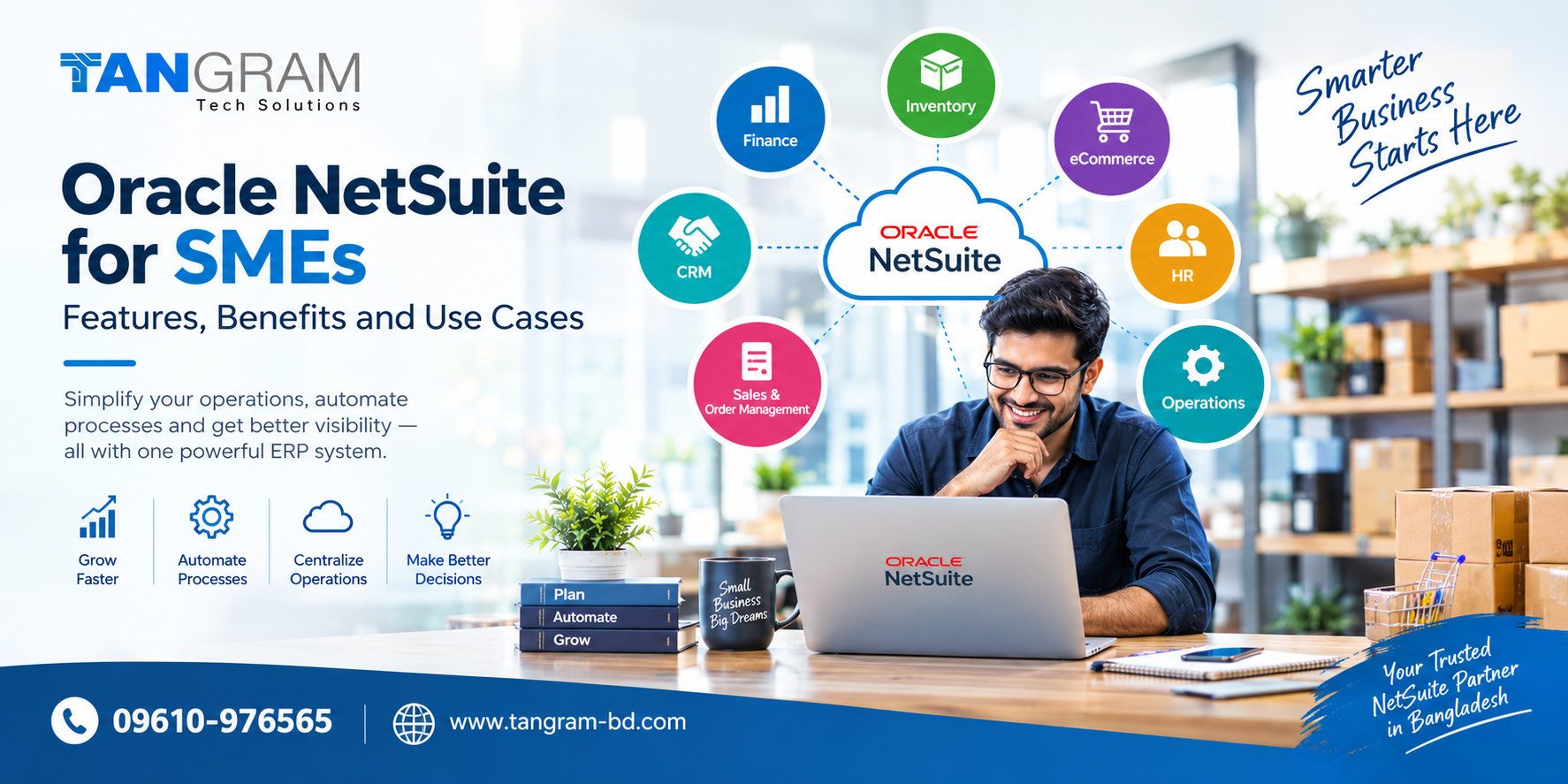
Solutions such as Oracle NetSuite provide businesses with a cloud based environment where important financial and operational functions can be managed through one platform.
For growing businesses, this can provide flexibility without requiring the same level of traditional infrastructure associated with on premise systems.
ERP and Business Transformation in Bangladesh
Businesses in Bangladesh are increasingly looking for ways to improve efficiency, manage growing operations, and compete in changing markets.
Companies searching for ERP in Bangladesh, ERP software in Bangladesh, or NetSuite in Bangladesh may be looking for more than accounting software.
They may need a system that connects finance, sales, inventory, purchasing, customer information, reporting, and other business activities.
For companies considering NetSuite ERP Bangladesh, implementation should begin with a clear understanding of the existing business processes and the areas that need improvement.
The right NetSuite Business Solution Provider can help with requirements analysis, implementation, customization, integration, data migration, employee training, and ongoing support.
Business Transformation Starts With the Right Questions
Before investing in an ERP system, businesses should look carefully at their current operations.
Where are employees spending the most time?
Which processes are still manual?
Where does information become difficult to track?
Are different departments working with separate data?
Can management access important reports quickly?
Is the current software able to support future growth?
The answers to these questions can help determine whether ERP is the right next step.
Conclusion
Business transformation does not happen simply because a company purchases new software.
It happens when technology helps people work more efficiently, information becomes easier to access, and business processes become better connected.
ERP can provide the foundation for this change by connecting important business functions, reducing repetitive work, improving visibility, and supporting better decision making.
For businesses exploring NetSuite in Bangladesh, NetSuite ERP Bangladesh, or other ERP solutions, the first step is to understand the problems within the current operation.
Once those challenges are clear, the business can choose an ERP approach that supports its present needs while providing room for future growth.
Website: www.tangram-bd.com
Contact: 09610 976565