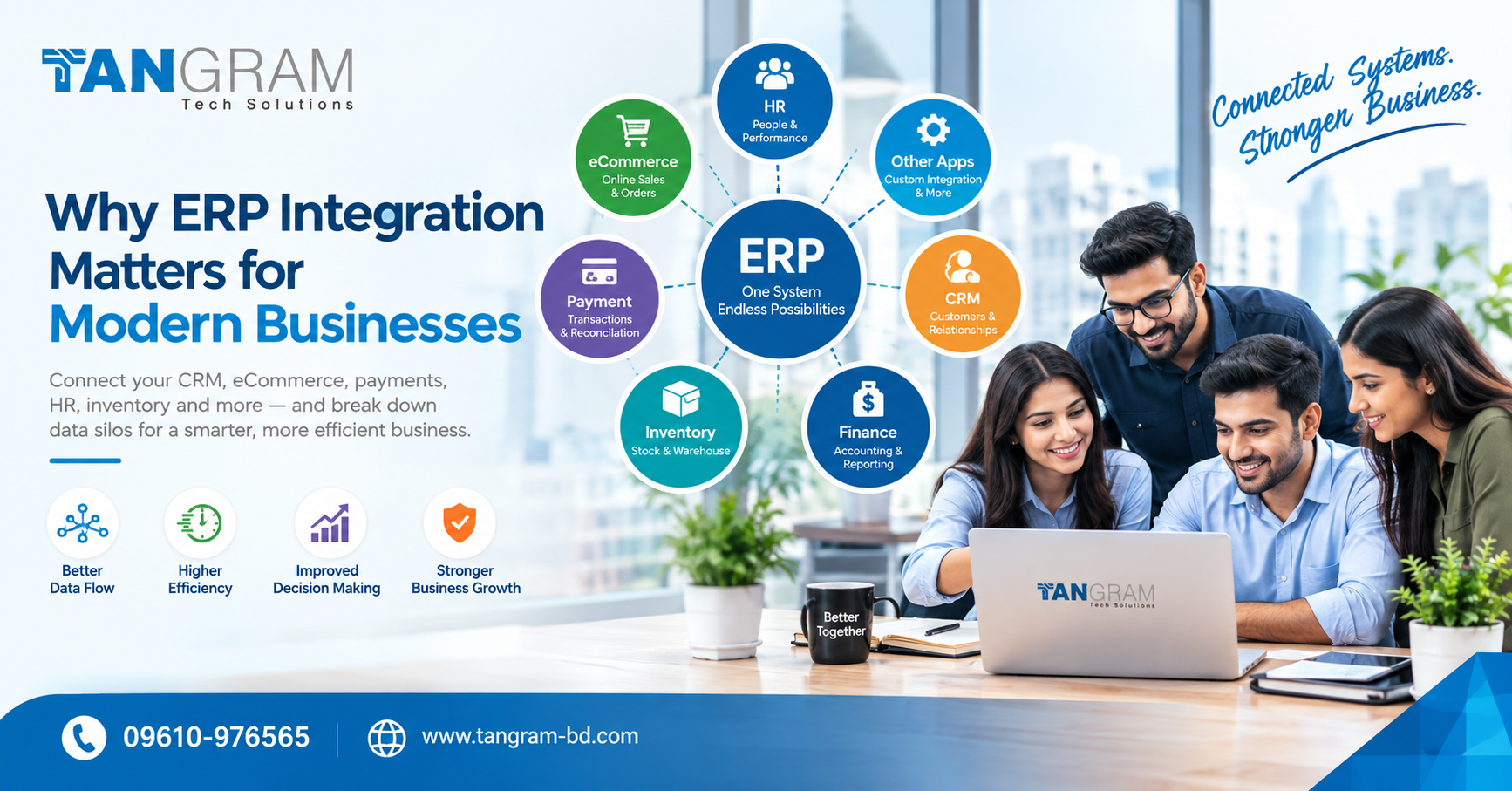
Why ERP Integration Matters for Modern Businesses
As a business grows, it often starts using different software for different parts of its operations.
The sales team may use a CRM, the online store may run on an eCommerce platform, the finance team may use accounting software, and the warehouse may have a separate system for inventory management.
Each system can be useful on its own. The problem starts when these systems do not work well together.
Employees may need to enter the same information more than once. Different teams may have different versions of the same data. Managers may also find it difficult to get a clear view of what is happening across the business.
This is where ERP integration becomes important.
What Is ERP Integration?
ERP integration means connecting an ERP system with other business applications so information can move between them more easily.
A business may connect its ERP with CRM, eCommerce, payment systems, HR software, inventory platforms, and other applications.
For example, when a customer places an order through an online store, the order details can be sent to the ERP. Inventory can then be updated, the finance team can receive the necessary transaction information, and the fulfillment team can see the order that needs to be processed.
The exact integration will depend on the systems a business uses and how its processes are set up. The main purpose is to reduce disconnected information and make daily operations easier to manage.
Oracle NetSuite provides integration options through technologies such as SuiteTalk REST Web Services, RESTlets, SOAP Web Services, and CSV imports.
1. Connect CRM With ERP
Customer information is often shared between sales, customer service, finance, and other teams.
When a CRM is connected with an ERP, employees can work with customer information alongside orders, invoices, payments, and other business activities.
This gives teams a better understanding of each customer without having to check multiple systems separately.
2. Connect eCommerce With ERP
For online businesses, keeping orders and inventory up to date is essential.
An eCommerce integration can send customer orders to the ERP while inventory and fulfillment information can be updated between the systems.
NetSuite Connector supports connections with eCommerce platforms and can synchronize information such as orders, fulfillment, and inventory.
This can reduce repetitive data entry and make it easier for businesses to manage their online operations.
3. Connect Payment and Financial Systems
Payments are an important part of the sales process.
When payment systems are connected with the ERP, transaction information can flow into the appropriate financial processes without employees having to manually move the same information from one system to another.
This can make the process from sales and payment to accounting and reporting more efficient.
4. Connect HR and Employee Information
As a company grows, managing employee information across different applications can become challenging.
Connecting HR related systems with an ERP can help keep employee and organizational information more consistent. It can also reduce some of the manual work involved in transferring information between systems.
The right integration approach will depend on the company’s HR processes, existing software, and specific requirements.
5. Connect Inventory and Operations
Inventory is closely connected to sales, purchasing, eCommerce, fulfillment, and finance.
When these areas are connected, a customer order can trigger updates to inventory and other related business processes. This reduces the need for employees to update each system separately.
For businesses managing multiple products, warehouses, locations, or sales channels, this type of integration can make day to day operations much easier to manage.
Why ERP Integration Matters for Businesses in Bangladesh
Businesses in Bangladesh are becoming increasingly dependent on digital tools to manage their operations.
Many growing companies now use several applications for sales, accounting, inventory, customer management, eCommerce, and other activities.
The challenge is not simply having different software. The bigger challenge is making sure those systems can work together properly.
Without integration, businesses may deal with duplicate data entry, inconsistent information, delayed reports, and unnecessary manual work.
For companies looking for ERP in Bangladesh, ERP software in Bangladesh, or NetSuite in Bangladesh, integration should be an important part of the decision.
How NetSuite Can Support Business Integration
Oracle NetSuite provides a connected business platform with integration capabilities that allow businesses to connect ERP information with other applications.
However, successful integration involves more than simply connecting two systems.
Businesses need to decide what information should be shared, when it should be transferred, who should have access to it, and what should happen if an error occurs.
This is why choosing an experienced NetSuite Business Solution Provider can make a significant difference.
Tangram Tech Solutions Ltd. provides NetSuite implementation, customization, integration, data migration, training, and support services for businesses in Bangladesh.
Conclusion
Modern businesses rely on multiple systems to manage their daily operations. When those systems remain disconnected, employees often spend more time moving information between platforms instead of focusing on important business activities.
ERP integration can bring CRM, eCommerce, payment systems, HR, inventory, finance, and other applications together, helping businesses work with more connected and reliable information.
For companies considering NetSuite ERP Bangladesh, NetSuite in Bangladesh, or other ERP software, integration should be considered from the beginning.
A well planned integration can reduce manual work, improve data consistency, provide better visibility, and help create a stronger foundation for future business growth.
Website: www.tangram-bd.com
Contact: 09610-976565