
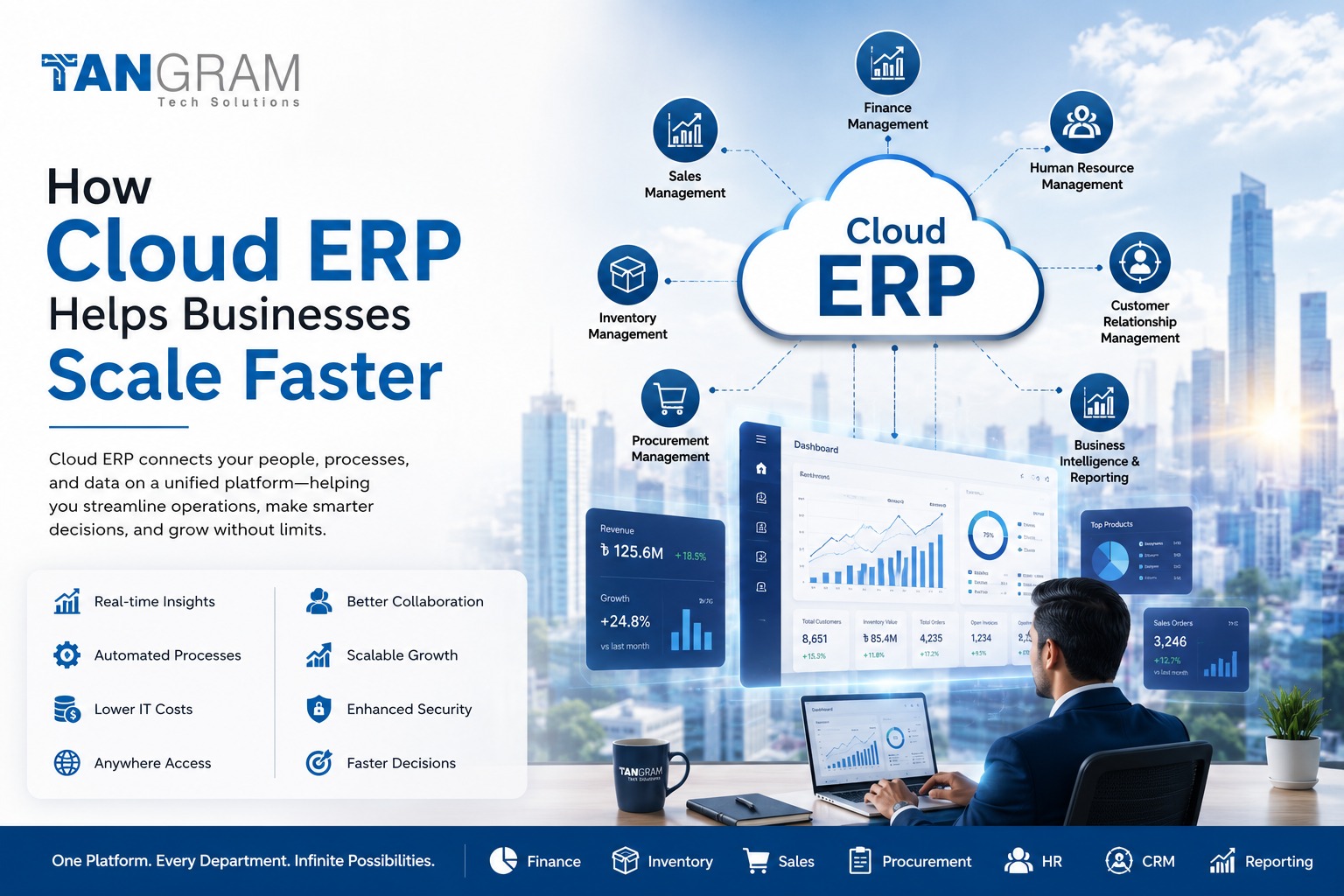

Business growth is an exciting milestone, but it also introduces new operational challenges. As companies expand, managing core business functions such as finance, inventory, sales, procurement, customer relationships, human resources, and reporting becomes increasingly complex. Processes that once worked efficiently with spreadsheets or standalone software often become slow, disconnected, and difficult to manage. Manual data entry, duplicate records, delayed approvals, and limited visibility across departments can reduce productivity, increase operational costs, and hinder business growth.
In today’s competitive and fast-changing business environment, organizations need more than basic software to keep pace with increasing demands. They require a solution that not only streamlines daily operations but also supports long-term scalability and smarter decision-making. This is where Cloud ERP (Enterprise Resource Planning) becomes a transformative business solution.
Unlike traditional on-premise ERP systems that rely on local servers and extensive IT infrastructure, Cloud ERP is hosted securely in the cloud, allowing businesses to access critical information anytime and from anywhere. It integrates all major business functions into a single centralized platform, ensuring every department works with the same real-time data. Whether it’s finance, inventory, procurement, sales, manufacturing, customer relationship management, or human resources, Cloud ERP eliminates information silos and creates a connected ecosystem that improves collaboration and operational efficiency.
One of the greatest advantages of Cloud ERP is its ability to automate repetitive and time-consuming tasks. From processing sales orders and managing inventory to generating financial reports and tracking employee performance, automation reduces manual work, minimizes human errors, and allows teams to focus on higher-value activities. As a result, businesses can improve productivity, deliver better customer experiences, and respond more quickly to changing market conditions.
Cloud ERP is particularly valuable for growing businesses because it is designed to scale effortlessly. As your organization expands into new markets, adds employees, opens new branches, or introduces new products and services, the system grows with your business—without requiring costly hardware upgrades or complex system replacements. Its flexibility, lower maintenance costs, automatic updates, and enterprise-grade security make it an ideal choice for businesses seeking sustainable growth and digital transformation.
For businesses in Bangladesh, where digital adoption is accelerating across industries, Cloud ERP provides a competitive advantage by helping organizations modernize operations, improve efficiency, and make data-driven decisions. Whether you’re a startup aiming to scale rapidly, an SME optimizing daily operations, or a large enterprise managing multiple business units, Cloud ERP provides the foundation for long-term success.
In this article, we’ll explore how Cloud ERP helps businesses scale faster, the key benefits it offers, and why more organizations are choosing cloud-based ERP solutions to improve productivity, reduce operational complexity, and achieve sustainable business growth.